41 years ago, I moved back to my birthplace, New York City, to study at the Art Students League. I'd gone there a few months three years earlier, but left, dissatisfied with the teaching I found there. When I returned, in 1976, I took the advice of a friend and enrolled in Robert Beverly Hale's class, "The Elements of Drawing".
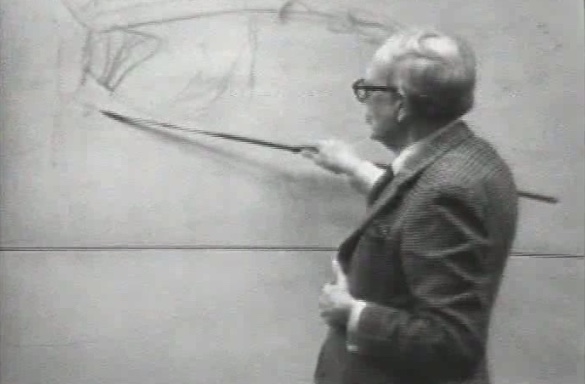
I wish I could ask, "what was I thinking?" but I know exactly what I was thinking. I wasn't looking for a teacher, but a Messiah. And this particular Messiah had no credentials other than the fact that he was a brilliant and entertaining lecturer and theorist. He would draw diagrams on a huge sheet of drywall, using a stick of charcoal mounted on a four-foot pointer, held at the back and manipulated with movements of the shoulder. It looked like a bravura performance. It was not until some 23 years later, when I began teaching, using the same tools, I discovered that this was not difficult at all, although it seemed to impress my twenty something students as much as it had impressed me when I was their age.
Hale had fascinating theories, and a zippy lecture style (which incidentally I have freely adapted for my own work teaching anatomy, figure drawing, and the Bible). He also was popular with the New York intelligencia; his students had included Muhammed Ali, Jackie Onassis and many others.
To his credit, Hale was a wonderful anatomy teacher; the five-eye proportional system which he invented and taught is a simple and mostly accurate means of handling human anatomy. If the class had purported to be nothing more than an anatomy class, or had I been less naive, I'd have been better served.
Unfortunately, "The Elements of Drawing" focused not only on anatomy, but also on light and shade, and on perspective. And Hale presented himself as an authority on drawing, whose lineage he could supposedly trace back as far as Titian. Which is peculiar in itself. Titian had teachers too, who probably could have traced their lineage back to Giotto. So why stop at Titian? But I guess I shouldn't look a gift lineage in the mouth: Hale trained me, so I guess I can trace myself back to Titian as well, and Giotto, and maybe the great cave painters. Street Cred is Street Cred.
Hale's teaching on anatomy was terrific, and his handling of perspective was good. But as far as light and shade, and on drawing in general, his ideas were elegant, sounded cool, and were tragically misleading.
I should have known better than to trust him. If you're auditioning teachers, or your kids or grandkids are doing so, please do what I didn't do: demand to look at your guru's paintings and drawings. If he has none to show you, there has to be a reason for this. No one who can paint well is going to balk at showing students what he's got.
In Hale's case, the subject didn't come up, although in unguarded moments, he would admit to being a man of immense self-doubt.
It is a kind of madness to decide that a man who has never walked down the path you wish to tread is a competent teacher of how to tread that path, let alone a great teacher. Yet the prominent art critics and book reviewers worshipped him. Don Holden, in his introduction to the DVD set of Hale's lectures, called Hale the only great drawing teacher America produced in the twentieth century. How in the world world Holden know this? Like Hale, he never learned to draw.
Hale didn't trick me. I hoodwinked myself. It wasn't till my forties, when I began teaching drawing and anatomy myself, that I realized how naive I had been. Even then I didn't see the trap I'd walked into. Hale the Theoretician appealed to a quirky side of my own personality, and when I realized that Hale's theories were misleading, I simply cooked up better theories. You can read about them in my book The Art of Figure Drawing. Fortunately, the book also contained some decent instruction, in addition to the theories.
Good drawings and paintings are not made by theoreticians, nor can they be made by the use of theories. Theory is mostly forensic in nature: you look back on successful pictures, see a pattern, and come up with theories. As far as learning to draw and paint goes, the only valid theory is to work yourself like a pack horse. Given talent, taste and good coaching, you might someday accomplish significant work. If it's really significant, maybe some future charismatic teacher will cook up some theories to explain how you did it.
Ultimately, Robert Beverly Hale's greatest contribution to our culture was a poetic view of the nuts and bolts of drawing, to the extent that he understood them. He was a critic, rather than a teacher or an artist. It's been said that it was more fun to read Pauline Kael than it was to see the movies she critiqued. Similarly, it's a lot of fun to read Hale's books, as it also was to sit through his lectures. He made the process of drawing look cool and fascinating. In doing so, he espoused a lot of ideas as gospel: that the trained artist does not draw what he sees, but draws what he knows. That mass conceptions are the artist's secret weapon. That what made the great masters great was their knowledge of anatomy. And that light and shade is entirely conceptual in nature. They're fascinating ideas which bear little if any resemblance to the actual practice of drawing, and absolutely no resemblance whatsoever to the higher discipline of painting.
But none of this posed a problem for Jackie Onassis, who attended the lectures and may have drawn well for an amateur, but who certainly had no designs on becoming a professional artist. There were dozens of people who attended Hale's classes year after year, chasing after a fantasy of doing important work, and for good reason: it's a lot easier and more fun to listen to a master lecturer than it is to actually learn how to draw and paint. Hale was an entertainer, filling a niche which he invented and perfected. He did no harm to his listeners, except the ones who seriously wanted to become competent painters, and who were naive enough to treat him as a Messiah.
Alas, there are no messiahs in art instruction, or at least none if they can't prove it with a backlog of genuinely great paintings and drawings. The classicists doing atelier training are far closer to the mark than a third-rate theoretician such as Hale. But even with such people, one ought to beware of treating their ideas as Received Truth. Great respect is due one's teachers. A healthy skepticism is due them as well.