The Delayed Gratification of Teaching

I am proud of never having messed with the teaching of drawing until I was in my forties. I ended up teaching at the Art Academy of Cincinnati after having attended an open studio figure drawing group there, and discovering that graduates of the school couldn't draw the nude very well. I asked them if there had been any instruction on anatomy for artists. There had not, at least not within the experience of these graduates, whose years spent at the Academy had been in the mid-1990s.

Having studied anatomy under a very charismatic teacher a couple of decades before, I believed that a class on the subject could be a good addition to the school's curriculum. There wasn't much other motivation, except the sheer fun of teaching. I'd taught anatomy once or twice in community education classes, but here was a chance to get at students who wanted to make drawing and painting their life's work.

Despite the unkind things I said a few days back about Robert Beverly Hale {see "Hale's Folly, and Mine", 10/4/2017). he was a very good anatomy instructor, and his very name was enough to get me an audience with Claire Darley at the Art Academy. I told her the sort of class I thought I could teach, and showed her some of my drawings. But it was Hale's name that ultimately got me an opportunity to deliver a sample lecture.

Ms. Darley pulled together a group of grad students and other interested people, and I did a sample lecture on the rib cage, introducing the five-eye system of proportions which I had learned from Hale. A few days later, she told me I could do a 1-1/2 credit class on the topic if I wanted to. I wanted to.

This meant, depending on the vagaries of the calendar on a given semester, thirteen to fifteen lectures on the anatomy of the human body. I tried to remember how many lectures Hale had. It probably was about the same. I broke up the body into segments and planned the course.

The only available time slot was Friday afternoons. Kids go home on Friday afternoons, they don't sit through lectures. As the signup deadline approached, there were only a handful of kids who'd expressed an interest. I agreed to do the class for almost nothing; I wanted badly to teach this material, and thought that once word got out, other kids would want in. So I did my lecture series to four students. The class consisted of an hour of lecture and two hours of supervised figure drawing.

I was 43, i think. That means that everything I had to say had been experimented with and tested for more than twenty years. I'd used the material doing illustration, painting, courtroom sketches for television, and even a stint doing portraits in bars to keep myself alive. Whatever misgivings I would later develop regarding Hale and his philosophy, the anatomy stuff was helpful, it worked, and it had all been tested in the crucible of my drawing and painting over the twenty years that had passed since I learned the material.

Maybe they ought to pass a law. Nobody should be allowed to teach art until he's had a few decades of experience under his belt, or hers. The majority of my students planned to become art teachers. If you're not willing to bet every chip you've got on your own talent, becoming a teacher makes sense, I guess. It's easier to become a professor than it is to learn to draw or paint competently, and it's certainly easier than learning how to make a living selling pictures. But easy does not mean right. Why begin one's career by compromising it? And from the standpoint of wanting to help equip students to do serious work, becoming a teacher in one's twenties is silly. What those students need is exposure to the lifestyle and habits of someone who's successfully slogged it out in the trenches, and prevailed. An art teacher, holing up in the protection of academia, is hardly equipped to generate working artists.

Was I a working artist prior to teaching? That might be a stretch. I lettered comic books. Occasionally I also did TV courtroom sketches, drew and painted book covers, and whatever else I could find to do. But I was hardly an example of a successful picture-maker. But I was an example of someone who understood human anatomy for artists, and who could use the information to draw the figure. That ain't ideal, but it's certainly a step up from a 27-year old armed with a master's degree seeking Tenure at the expense of Truth.

Not everyone is cut out to teach. Whatever other gifts I may lack, I've got that one: teaching, like storytelling, is a seductively wonderful pleasure. Engaging an audience is an act akin to romance. It's magical. My four students got their money's worth, and the class was green-lighted for the following year.

The Human Anatomy for Artists class, buried in the boneyard of the Academy schedule, had to be promoted to survive. So I began designing posters advertising the class. I'd hang them all over the Academy's two buildings. Here's one of them:
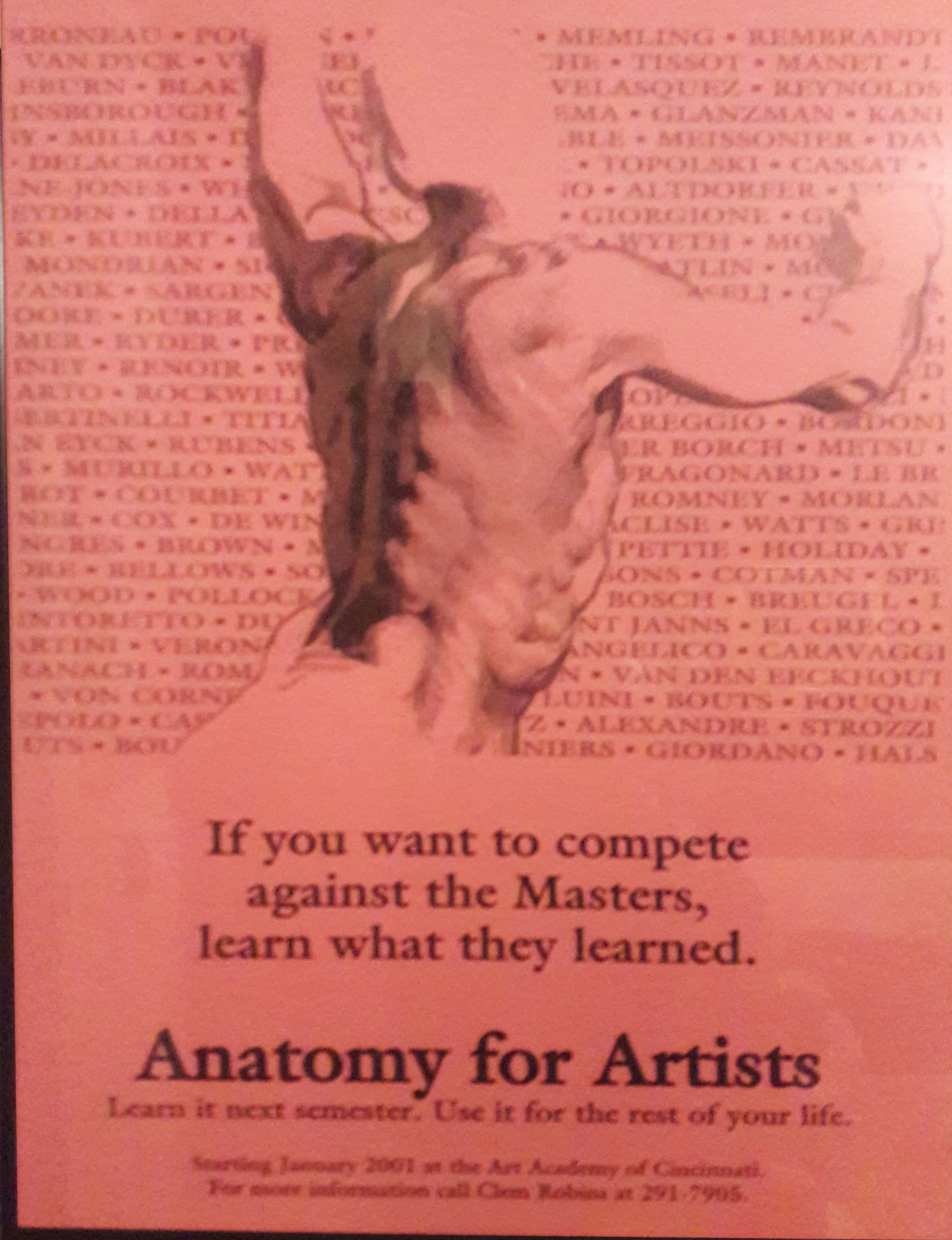
poster.jpg

"Learn it next semester, use it for the rest of your life" was soon supplanted by the slug line which was used for the class during the remaining five years of its existence on the Academy schedule: "Ask Anyone Who's Taken It". And sure enough, word got out.

None of this is due to my brilliance as a teacher or lecturer. It speaks more to a craving, at least among some of the Academy students, to be told what was right and wrong. Human Anatomy for Artists was boot camp, and a surprising number of students wanted just that. The number of students increased, and when the Academy permitted students to take the class a second time for credit, the result was a steady stream of students, and the class was offered both semesters, every year. I got to teach a few other subjects, as well.

It was a precious time for me. It never could have happened as well had I been in my twenties or thirties. One's forties are about right. If what you know works, why not share it? Anatomy for Artists came on the scene at a boom time in the comic book lettering biz. Every time I headed to the Academy to teach, I lost money compared to what I could have made doing comics. My wife understood it. It was a joy time, a time to pass on the cream of what I'd been taught. It was magical. If teaching's your bag, and if some years under your belt have qualified you to teach, perhaps it's something you ought to be doing.

One addendum. The poster shown above has a list of a few dozen of the great figure artists of the western world. Having spent most of my adult life in comics, I wanted badly to include at least one representative of that industry in the poster. If you look close, on the left side, on line 9, you'll find the name KUBERT. Joe Kubert is without a doubt the greatest figure draughtsman who ever drew comic books. I had the privilege to call him shortly before his death, to tell him about the poster and his inclusion in the Hall of Fame. He was old enough, wise enough, and humble enough to understand what this meant. He went to his grave knowing what at least one person believed about him and his body of work. If my stint at the Art Academy of Cincinnati accomplished nothing more than that, it would have been well worth it.

But the class juijitsued into some other realms: it brought me into contact and friendship with some very talented students, many of whom remain my friends to this day; it exposed me to the backstage world of academia; it gave me a chance to eulogize my father, six years before his death and in his own presence; and it opened the door for me to write a book on figure drawing. Life's full of serendipity if you keep your eyes open.
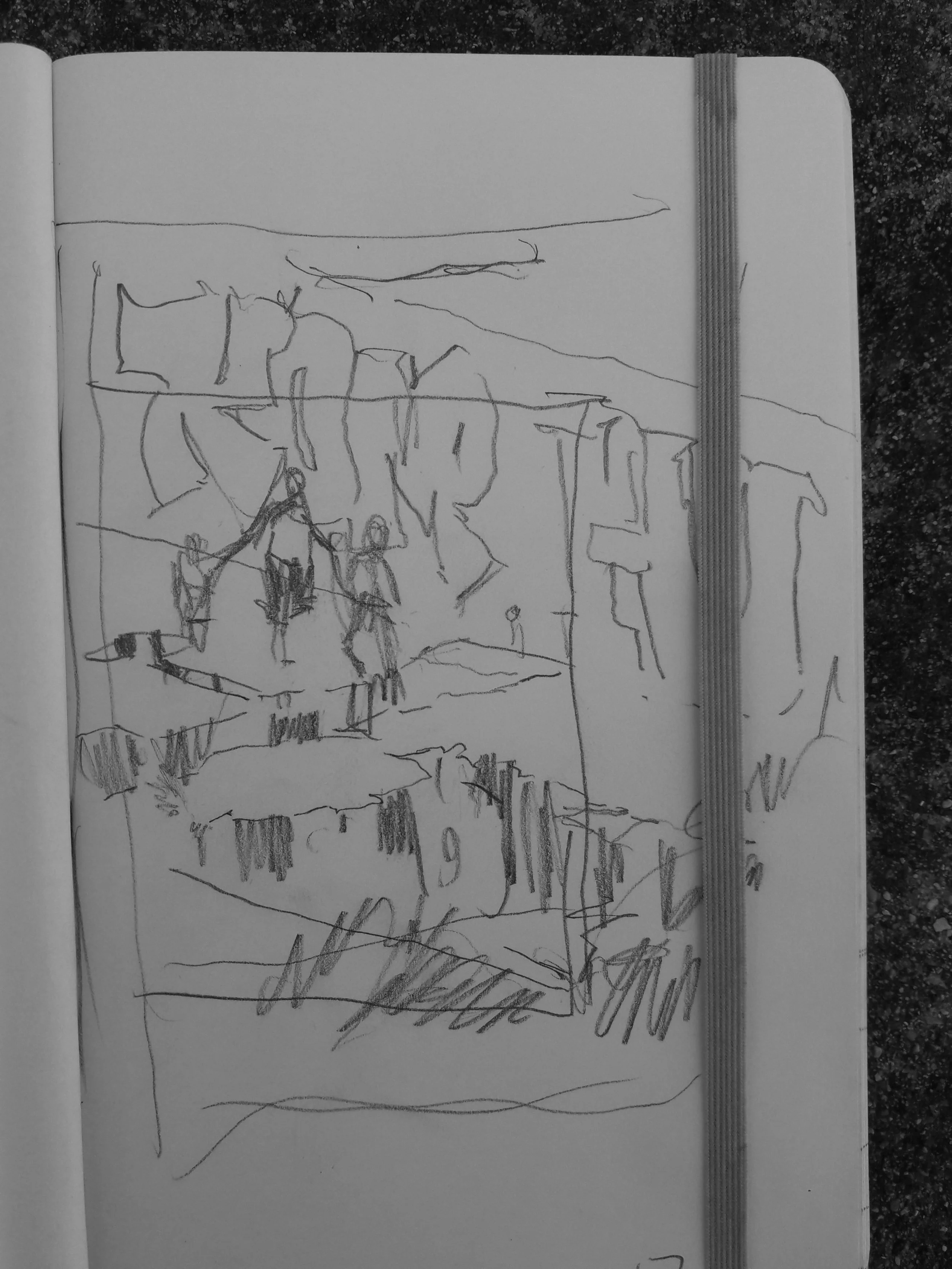
Duck Creek Spillway Revisited

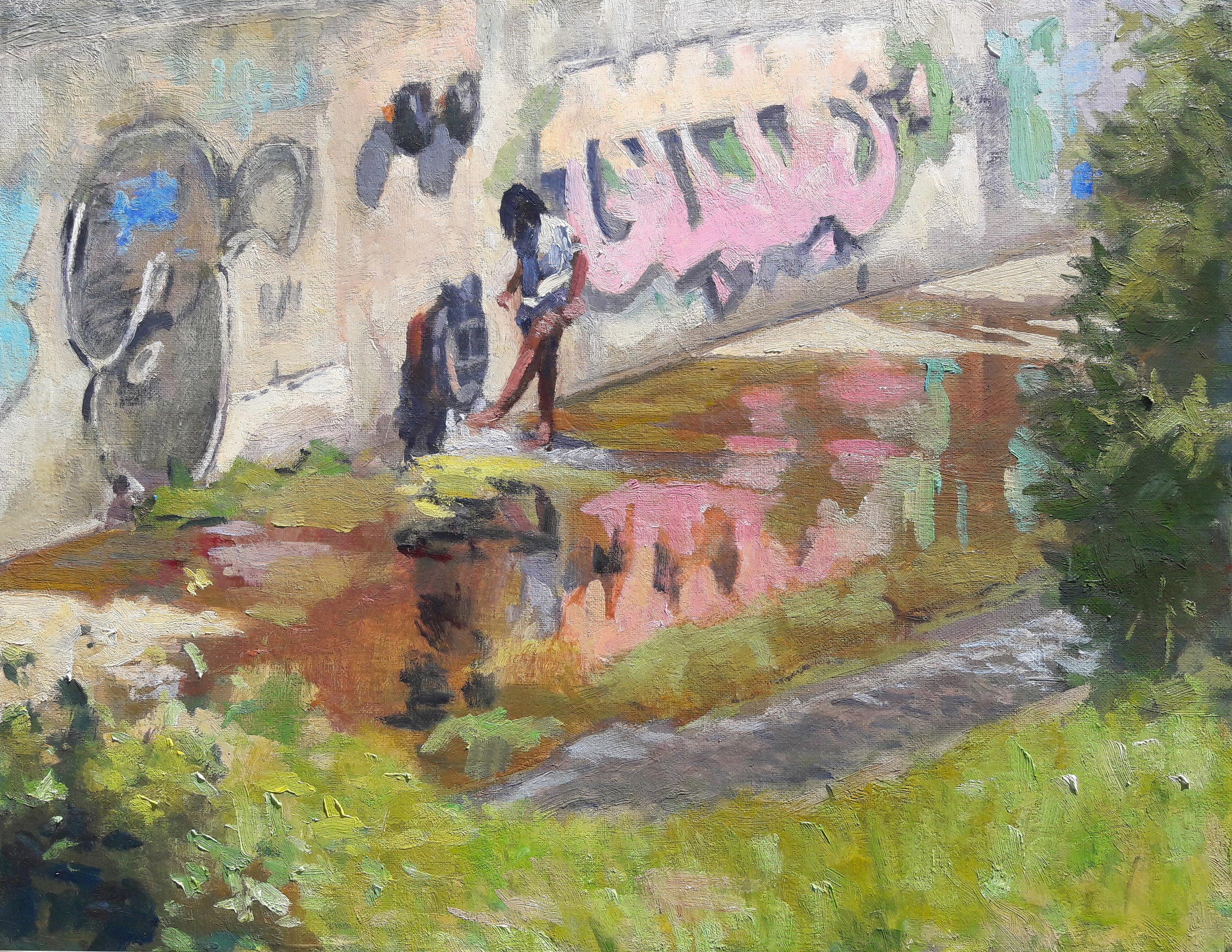
Andrew Wyeth had Helga, Van Gogh had Dr. Gachet, Cezanne had Mt. St. Victoire, and Monet had his haystacks. Iconic models, objects or vistas associated with the masters. Me, after finding a fascinating blend of cityscape, female beauty and urban culture at the Duck Creek Spillway, I resolved to do something more ambitious with the motif.

In case you weren't here for my earlier post, here's my June picture of a woman washing her feet in the sluice gate of the spillway, surrounded by graffiti:

6_10_2017_day5 2.jpg

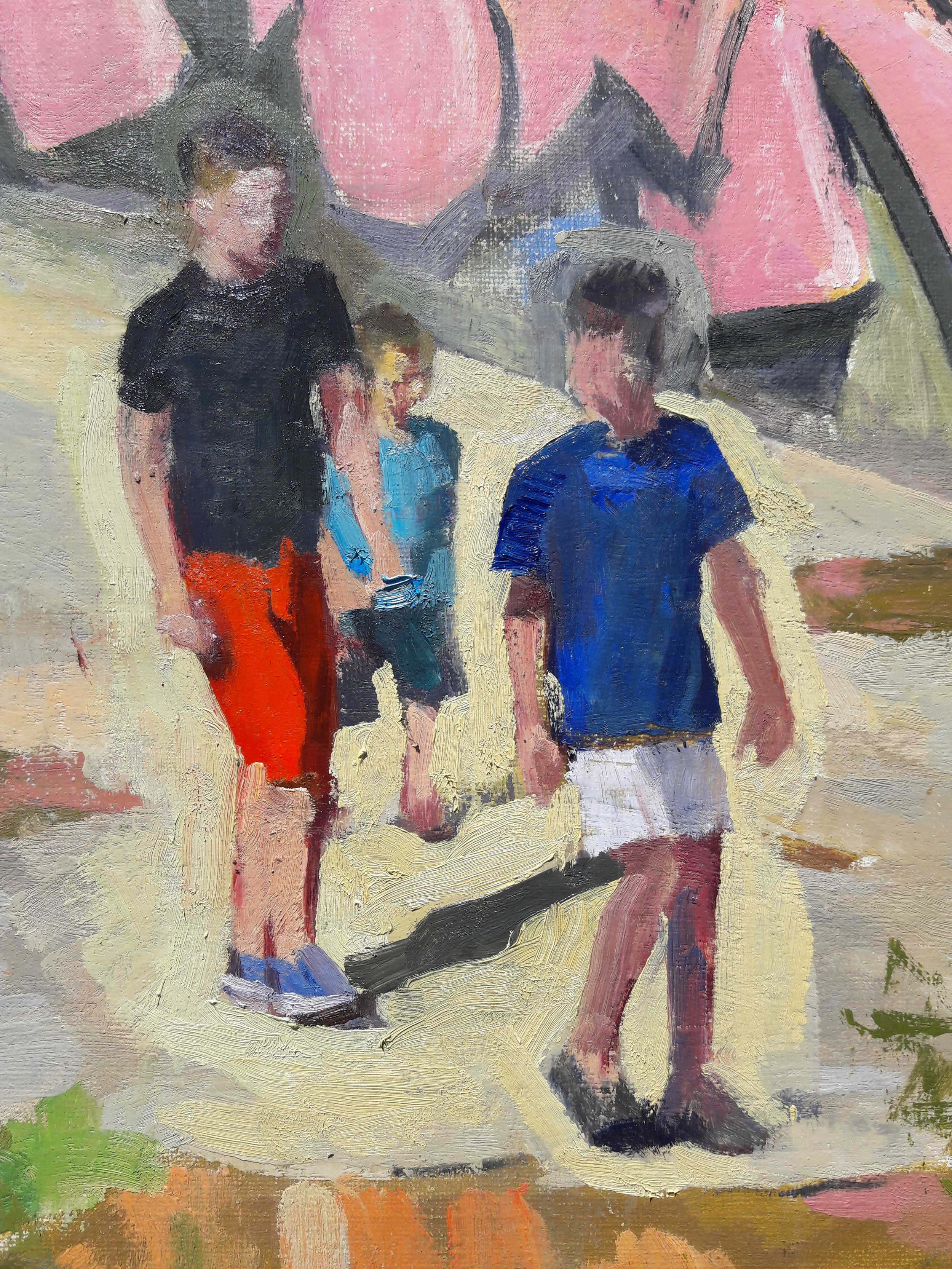
I had ideas of childhood summers and forbidden places, things which I thought might make something more profound of the motif. I have two grandsons, aged (at the time) 10 and 11. This is a wonderful time to be alive. Just old enough to break free of mom's apron springs and go places where you don't belong, but still young enough to be really creeped out about the whole thing. Where better to go than a spillway? What better time than on summer vacation? What better age than on the cusp of puberty? The story had everything, or so I thought. I arranged with my son and daughter in law to borrow two kids for a painting and photo session.

6_20_2017_thumbnail.jpg

So there they went, the ten and eleven and, as a special bonus, a three year old brother. All the best ideas come from childhood. This is the age to wander where you don't belong, among the graffiti and the rats. Better still if you bring your toddler brother along.

6_2_2017_color sketch.jpg

Summers are great times when you're a kid, but the summers when you're ten or eleven are the magical ones. Maybe the problem with this picture had to do with my having to get the parents' permission to pose these kids where they didn't belong. Is forbidden fruit really forbidden when you ask permission?

11.12a.jpg

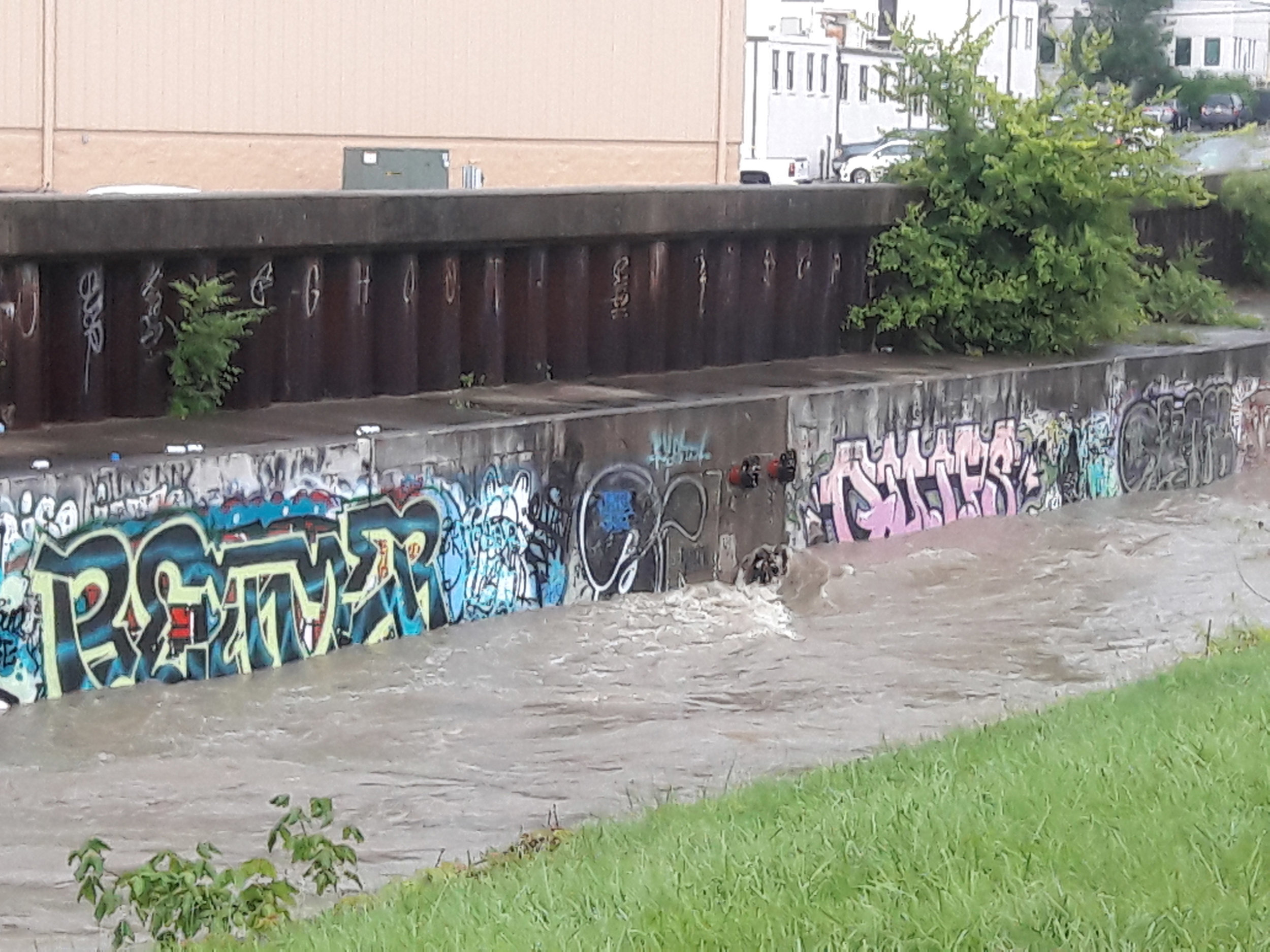
Of course, the fact that certain locales are forbidden doesn't necessarily mean a ten year old should go there. Here's that same spillway after a half hour of hard summer rain. My grandkids might have found it fun for the first thirty seconds, but then the raging waters would have carried them into uprooted trees and pilings, and spoiled their fun.

Still, I wanted to make a picture about kids going places where they don't belong, danger or no danger.

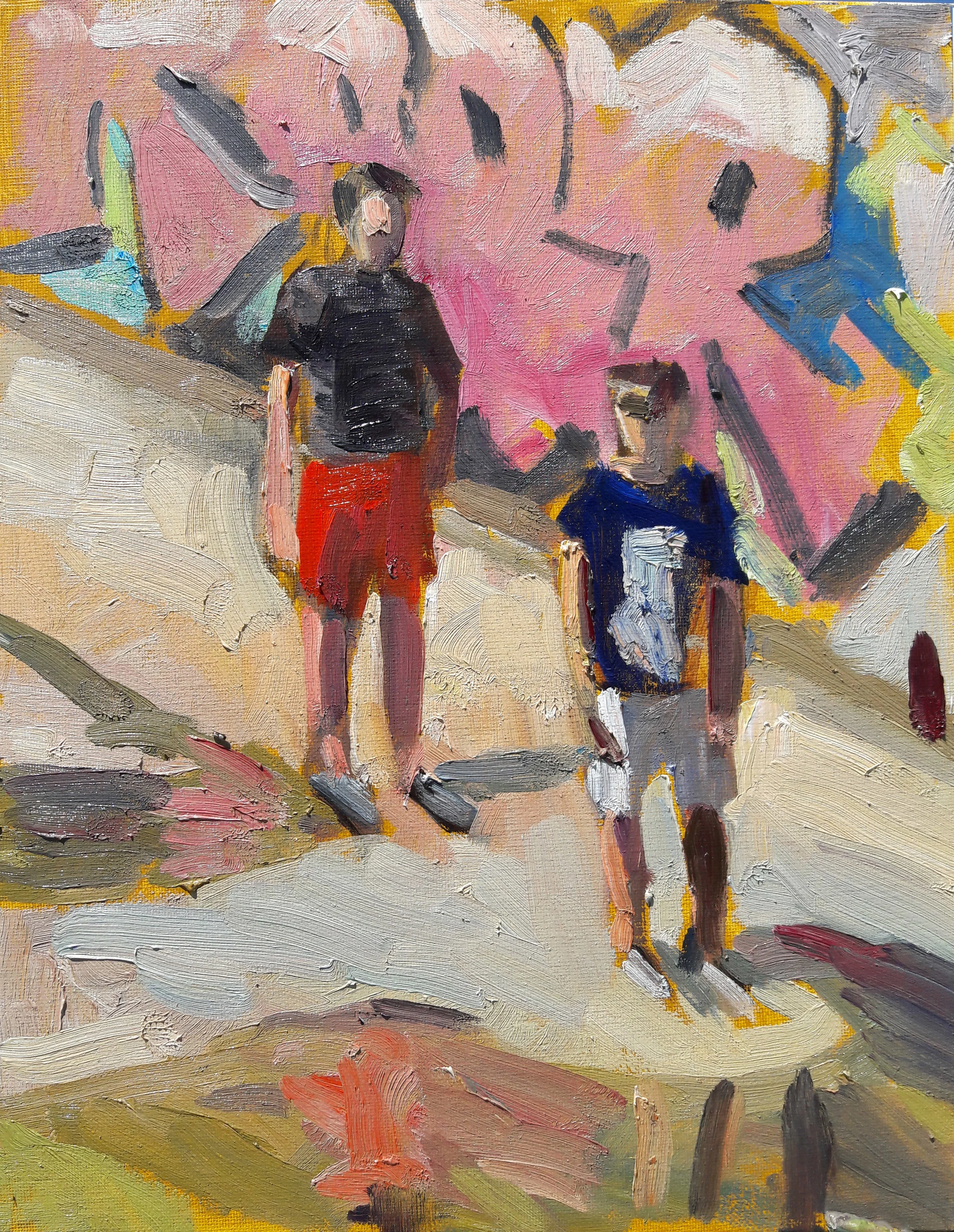
Come the next clear day, I once more had access to grandkids, aged 11, 10 and 3. Oil is a surprisingly cooperative tool for sketching. That Magic Summer, you know? The one where floodwaters nearly made strawberry jam out of us all. The story had everything. Rod Serling would have made a Twilight Zone episode out of it all.

But it just plain didn't please me. Not visually, anyway. I love my grandkids, and I love the emotional resonance of summer and heat and forbidden places and no parents. But the sketches just didn't click, no matter how hard I tried.

And so ended Duck Creek Spillway, Opus 2. I had one more trick up my sleeve.

The Green Shed, Part Two

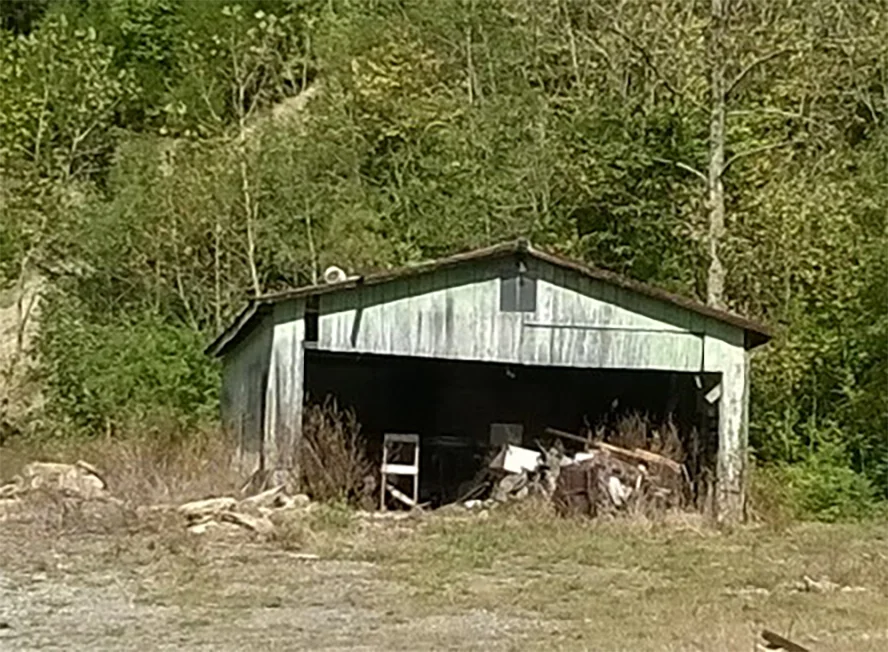
A year after completing the small picture of the green shed, I returned to the same spot, to try again on a 16x20" canvas. Here's what I found:

10_4_2016_motif.jpg

There were some improvements in the scene after a year. The grass was overgrown, obscuring most of the bottom of the opening. A piece of plywood lay against the right border. I moved thirty feet to the right, allowing a large bush to cover the right border of the shed. What all of these things did was to break up the big rectangle shape which looked so dull on the previous attempt to paint the scene.

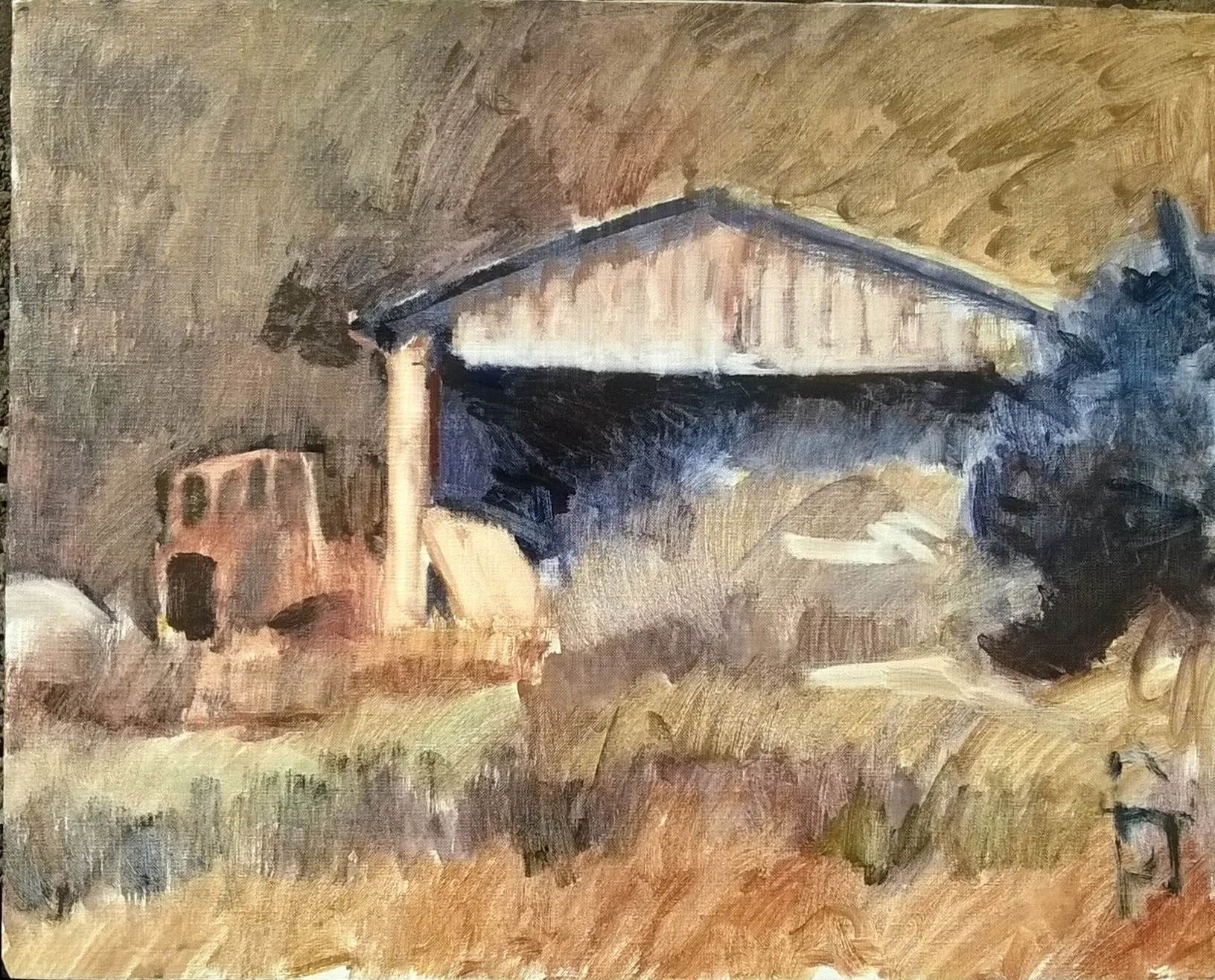
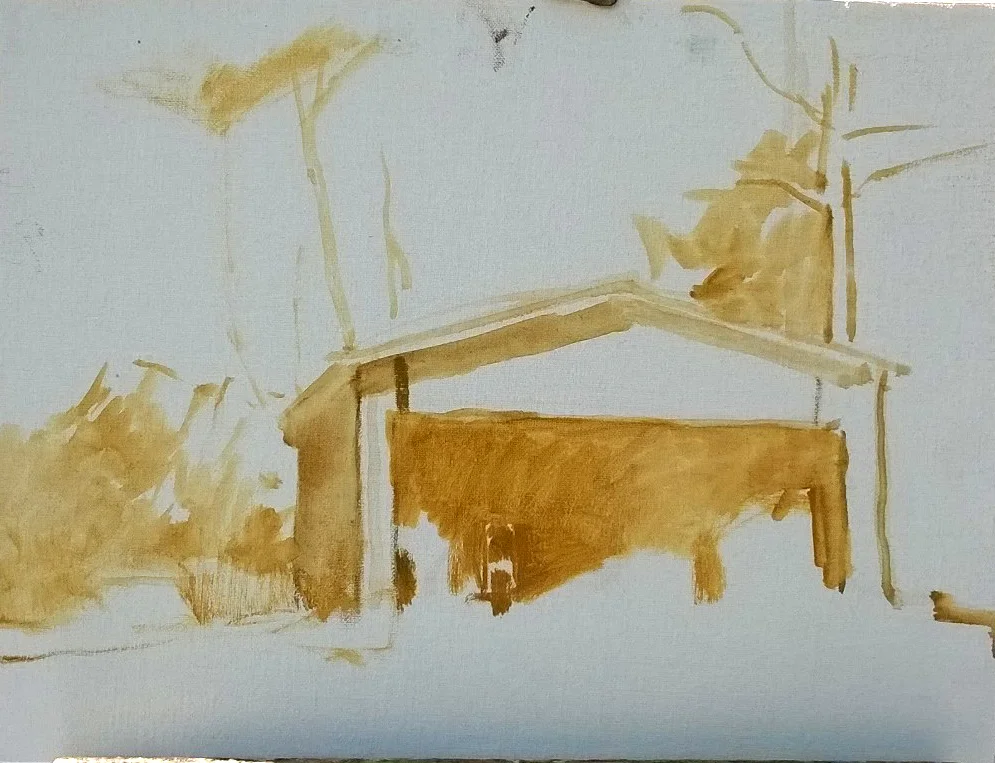
10_4_2016_day1.jpg

So this was the first day's work, rubbed in thinly. The little scribble on the lower right, the thing which resembles Chinese calligraphy, was actually a note I made to myself to sneak a red hydrant into the picture, which actually lay outside the scene.

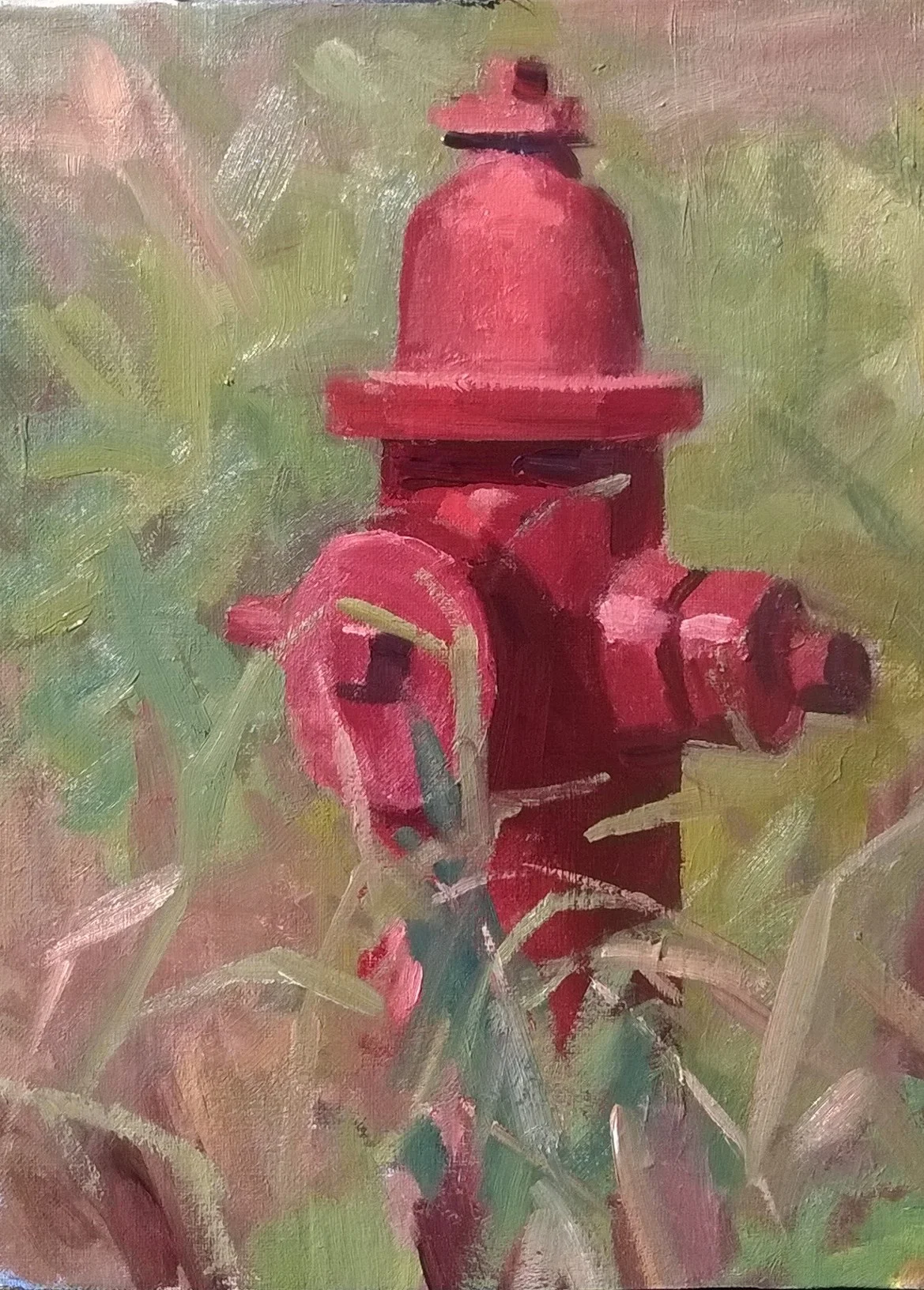
hydrant_day2.jpg

Sometimes it's helpful to do a drawing or oil sketch of a something you intend to paint. If nothing else, it makes you comfortable about it.

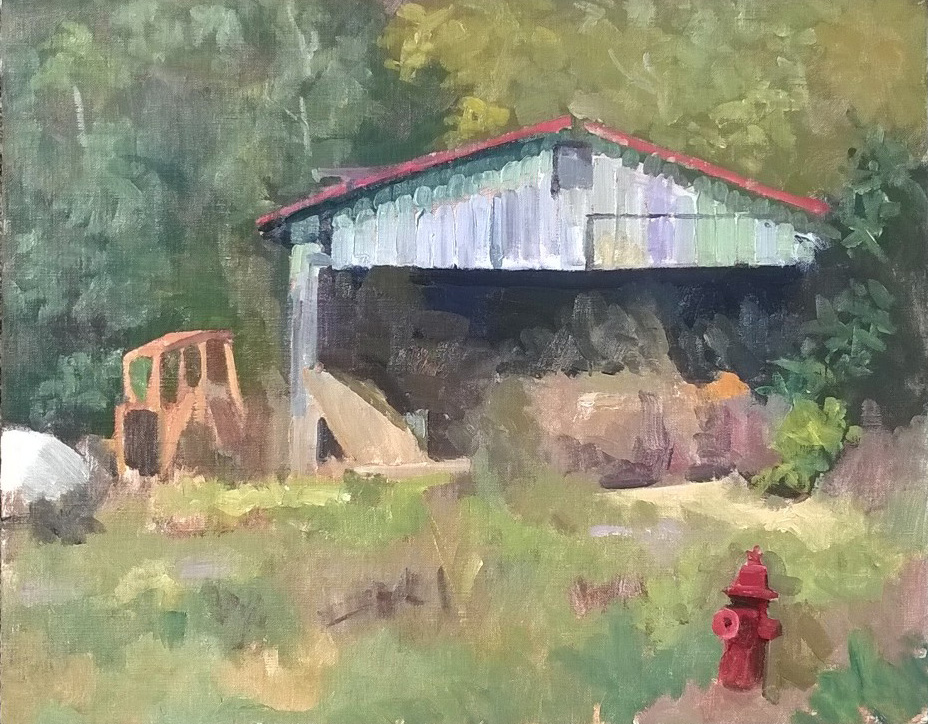
10_4_2016_day2.jpg

So here's how it looked, with  the hydrant and a first attempt at color. I thought the hydrant would be more interesting if I tilted it a bit. The bulldozer and water tank on the left didn't seem to be earning their keep.

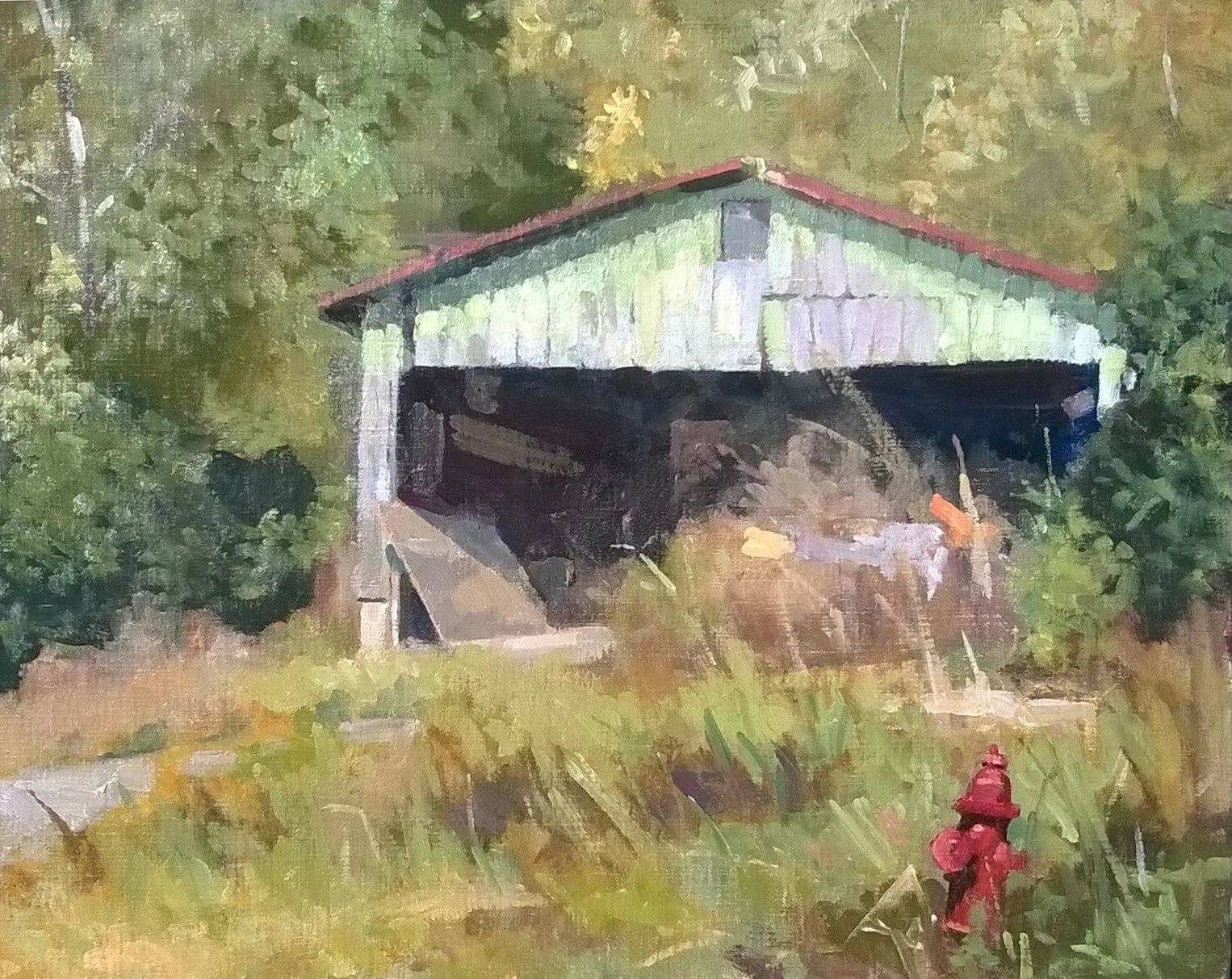
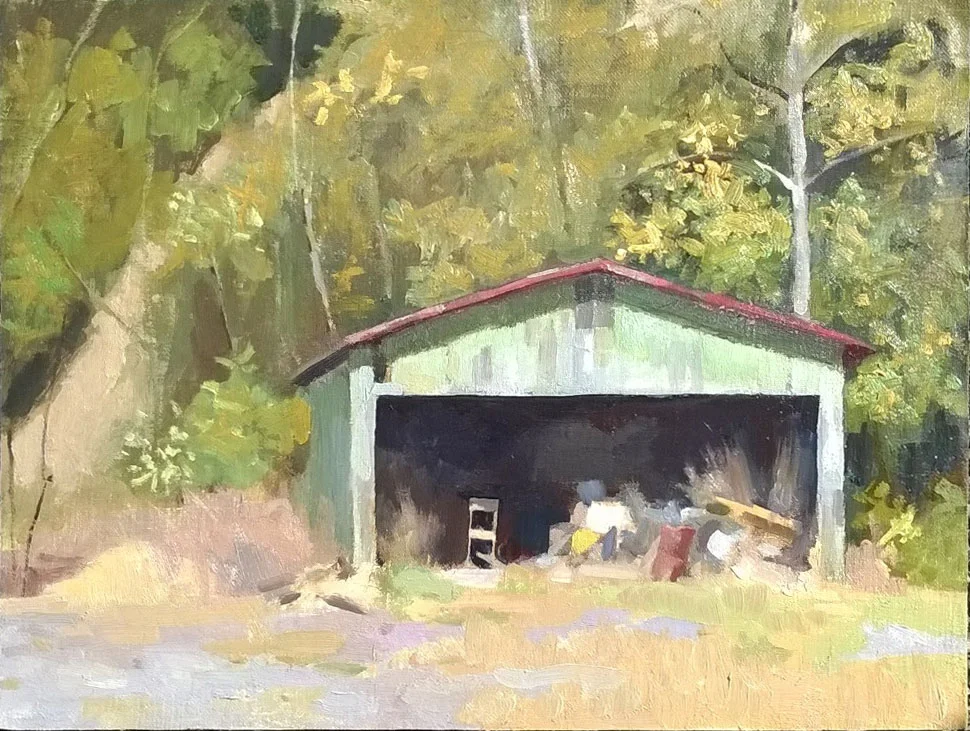
10_4_2016_day4.jpg

So here's how the picture ended up. I think it's a much stronger image than the previous year's.

The Green Shed, Part One

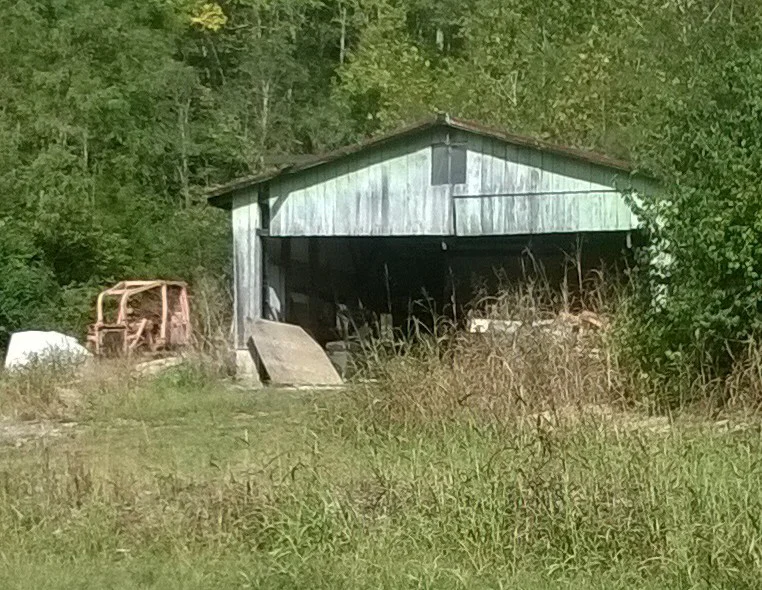
My friend Craig Gilkeson allows me free access to his property in Batavia. Two years ago I was wandering around there in search of a motif and blundered across a green shed that I found interesting.

10_6_2015_motif.jpg

The green isn't all that clear in this photograph. It's a coat of paint from probably fifteen years ago, nicely weathered. I thought a picture could be built around the shed.

10_6_2015_day1a.jpg

In the least common denominator, a painted image is simply a pattern of lights and darks. So it can be a good procedure to begin by indicating what's dark and what isn't, using a paint color that's muted enough that it won't have too strong an effect on what is to be painted over it. This is yellow ochre, cut with a little bit of ultramarine. Ochre is very cooperative, unlike some other pigments which instantly stain the canvas. You can remove ochre fairly easily with turpentine and a rag.

There would prove to be problems with this composition, problems that I would not notice for a year after finishing this little picture, although looking at the initial work above, the biggest problem is immediately apparent: two tree trunks which appear to grow out of the two sides of the shed, like the antennae on a set of rabbit ears. But this particular problem was not apparent to me at the time.

10_6_2015_day1b.jpg

So here I was at the end of Day One, which happened to be October 4, 2015. Those two antennae are even more apparent now, although i still didn't notice the problem. Worth recalling is that nature's patterns tend to be better than anything you or I could dream up, so I tend not to be suspicious of what I see. But those two tree antennae where exactly where i placed them. Here was clearly a case in which nature needed a little bit of nudging.

But this was a pretty good first day. The canvas, which happened to be an 11x14", is covered, the values are correct, as are the colors, for the most part.

10_6_2015_day4.jpg

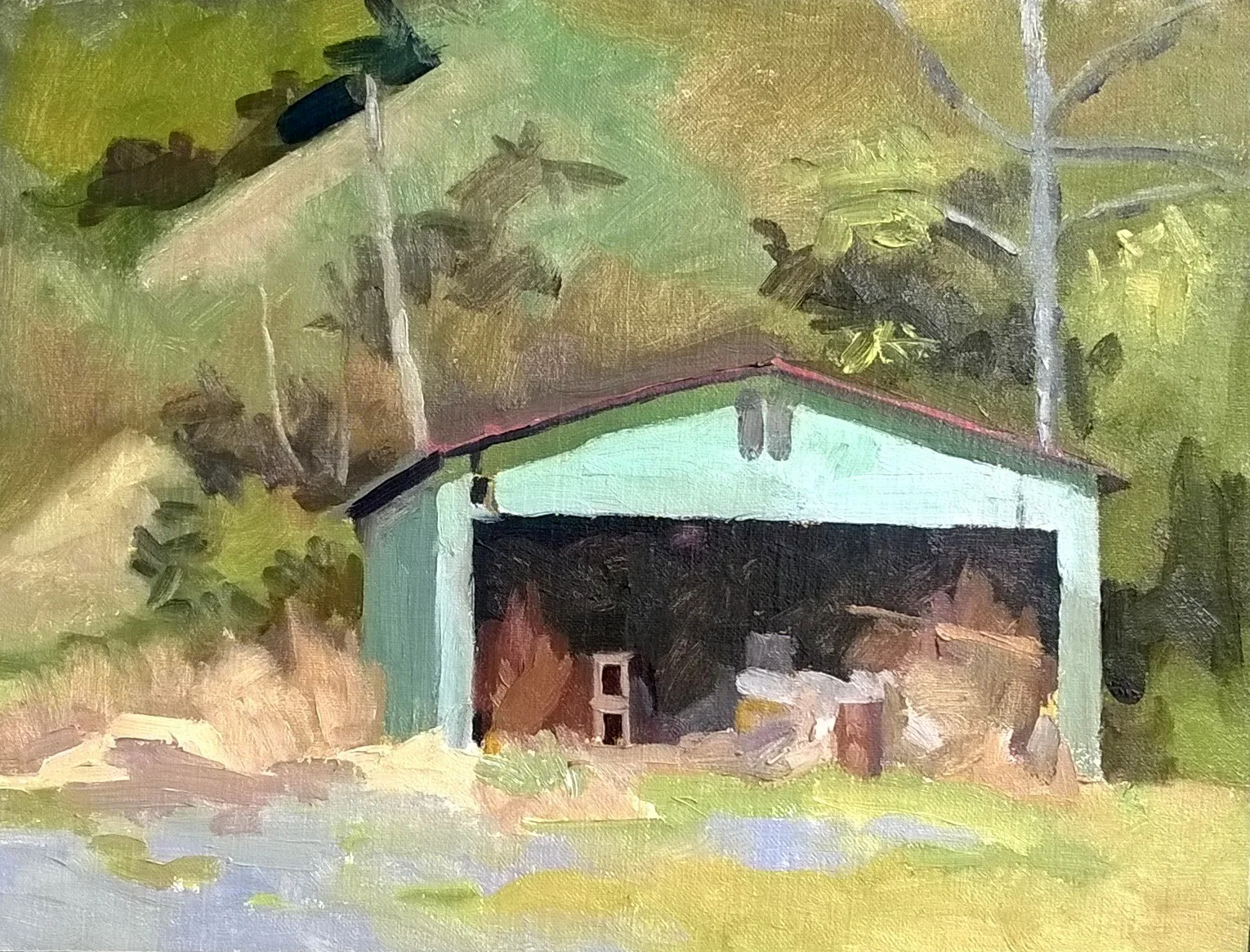
I put in four sessions on the shed. Here's what I came up with. I liked it but didn't love it. Certainly I didn't love it as much as I loved that shed with the muted, fading green paint. I stuck it on a shelf and forgot about it, except that whenever i glanced at it, those antennae bothered me more and more.

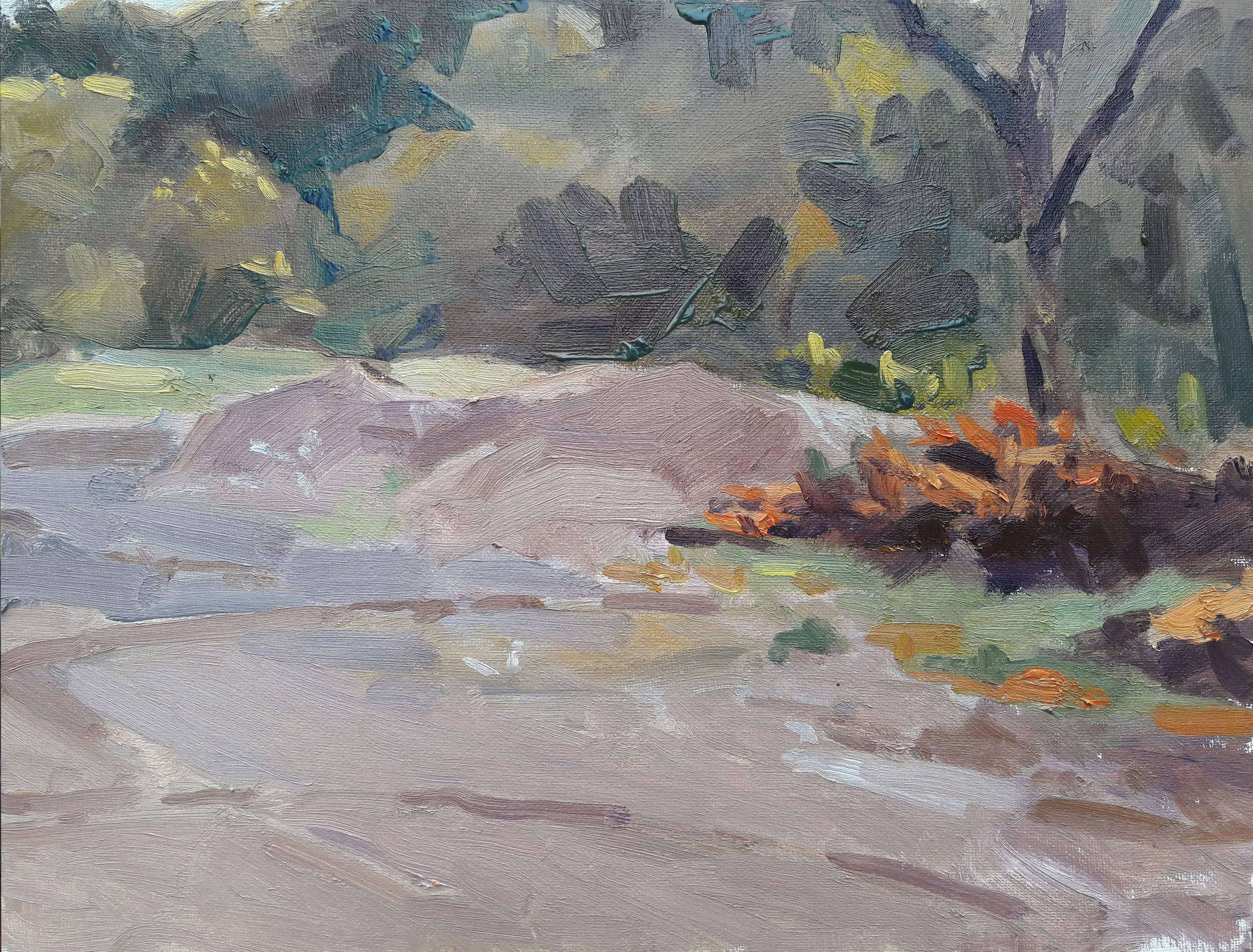
There were other things that bugged me. The shed is almost perpendicular to one's line of sight, which is rather dull to my eye. The vertical brushstrokes describing the ground plane defeat their own purpose; you can, and should, use the direction of your brushstrokes to indicate the thrust of a surface. The flatness of the ground could have been communicated that way. For example, below is a landscape sketch I painted yesterday. It's not finished, or particularly satisfying, but the brushstrokes describing the ground plane produce the sensation of flatness which is necessary to me:
 

10_9_2017_day1.jpg

No offensive vertical brushstrokes on the ground to spoil the effect. I know a little more than I knew two years ago.

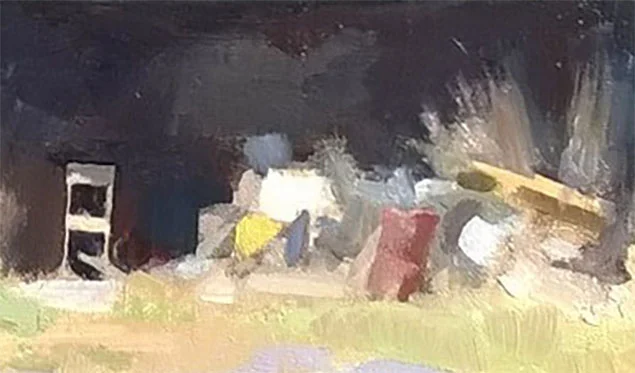
There's one more problem which stuck out to me in the 2015 opus, a problem that may not have been egregious had the picture been bigger. Take a look at a detail of the junk seen inside of the shed:

10_6_2015_day4_detail.jpg

One might think that in a small picture you can get away with less detail. But a small picture invites the viewer to look close at its surface. This roughly drawn mass might have looked fine in a larger canvas, but here it is quite unsatisfying.

All told, the 2015 Green Shed opus was an honest attempt, honest enough that its problems are hard to ignore. A year later, I would decide to return to that spot and try again.