The Landscape Still Life

Still life is usually painted in the studio, under controlled light. Delacroix did some open air still life, and probably other people, but mostly it's an indoor sport.
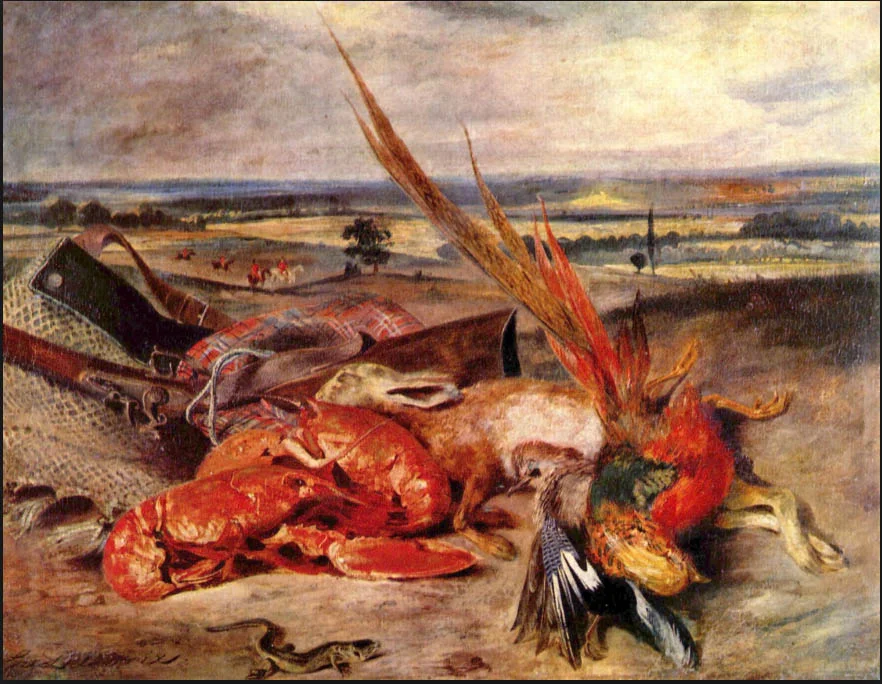
Not one of Delacroix's more famous pieces, or even one of his best, but has always had a kind of wild charm. A series of objects more suited to Chardin than the Romantics, but instead of chiaroscuro, painted in plein aire light.

Not one of Delacroix's more famous pieces, or even one of his best, but has always had a kind of wild charm. A series of objects more suited to Chardin than the Romantics, but instead of chiaroscuro, painted in plein aire light.

But once upon a time I was out in my truck hunting for landscape motifs, and blundered into a series of manmade objects which caught my eye, a bunch of nondescript objects lying by a barn in Batavia, Ohio. Most of them I couldn't even name. Nor did I, as I have been taught, rethink their arrangement in abstract terms, and then move them around to suit my fancy. This was a Found Arrangement, and it didn't want any alterations from me.
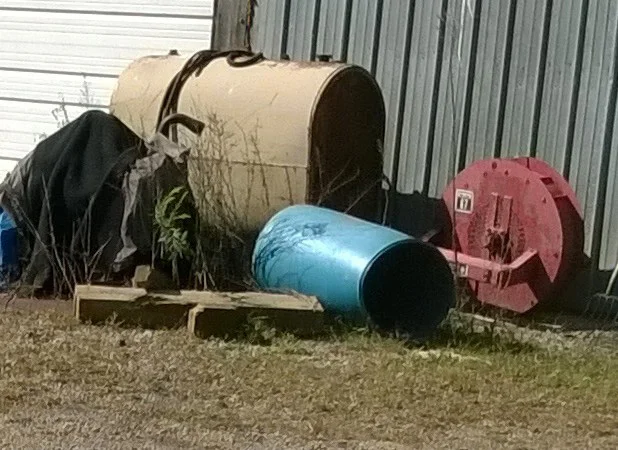
10_12_2016_motif.jpg

Exactly what I found so charming is hard to put into words, although the preponderance of the three primary colors certainly was a factor. The blue tube — I have no idea what it actually was — had a brilliant highlight I admired. The block of wood's side plane was lit up by reflected light from the ground, although this can't be seen from the photograph. I don't know. I just dug it.
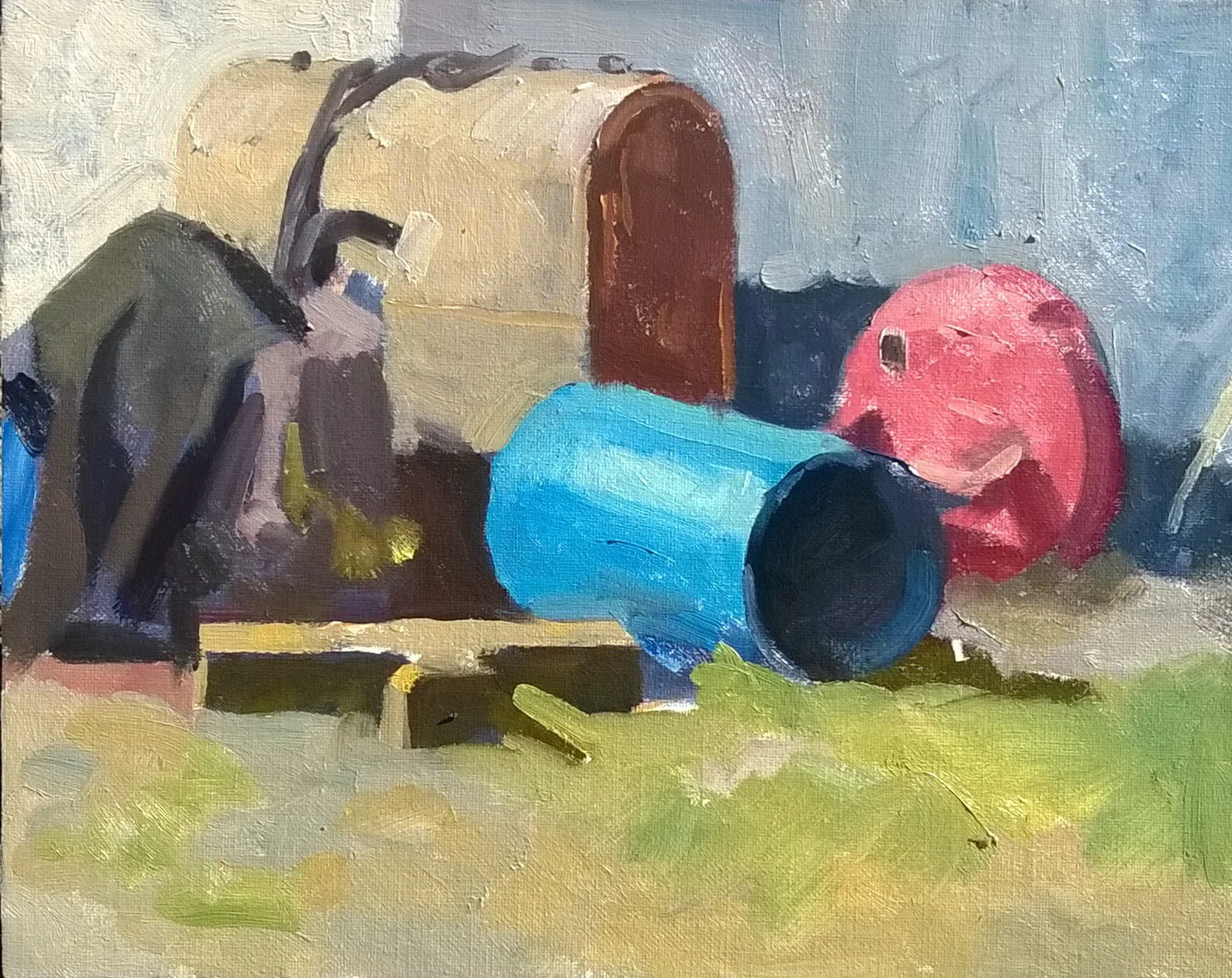
10_12_2016_day1.jpg

It was certainly worth a 16x20" canvas, and I just happened to have one such canvas in my truck. I went at it, although the three primary color notion was lost when I began scribbling in a green for the dying grass.

I loved placing the setup off to the side. I loved the rhythm of the objects, which I did my best not to screw around with. It just seemed peaceful, and pleasing, and in its own humble fashion, profound.
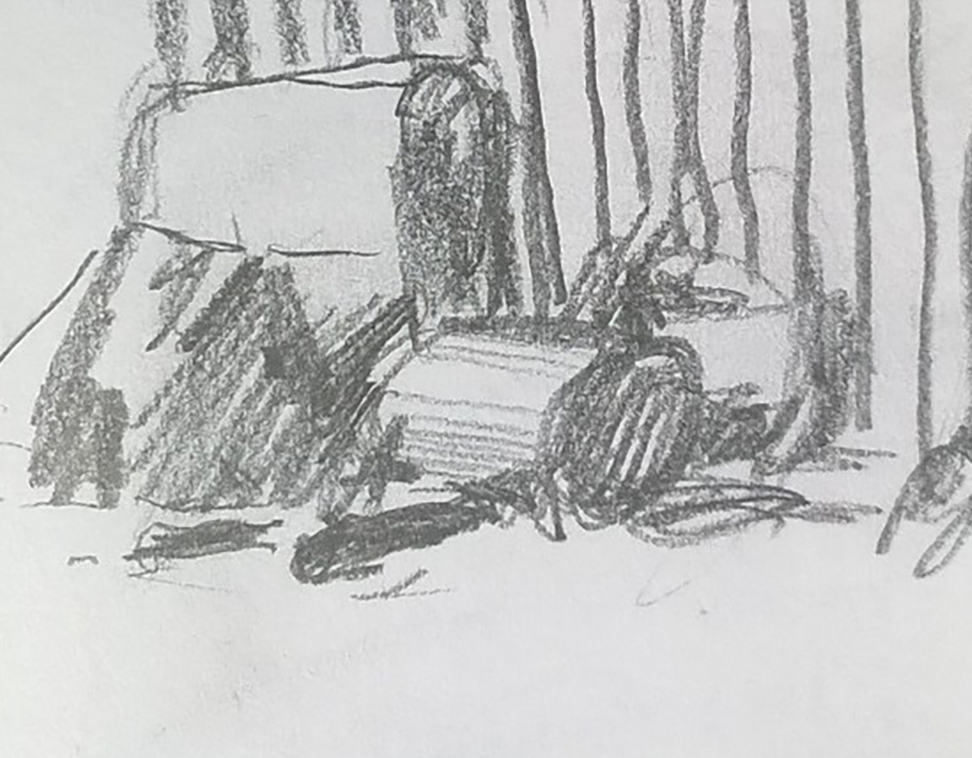
10_10_2016_sketch2.jpg

I generally do better work if I've taken the time to scribble the whole scene in pencil, which I did do here. Hardly a drawing to win a beauty contest, but it captured the melody of the scene, and gave me an idea of what I was trying to accomplish. This sketch was done before the above lay-in.
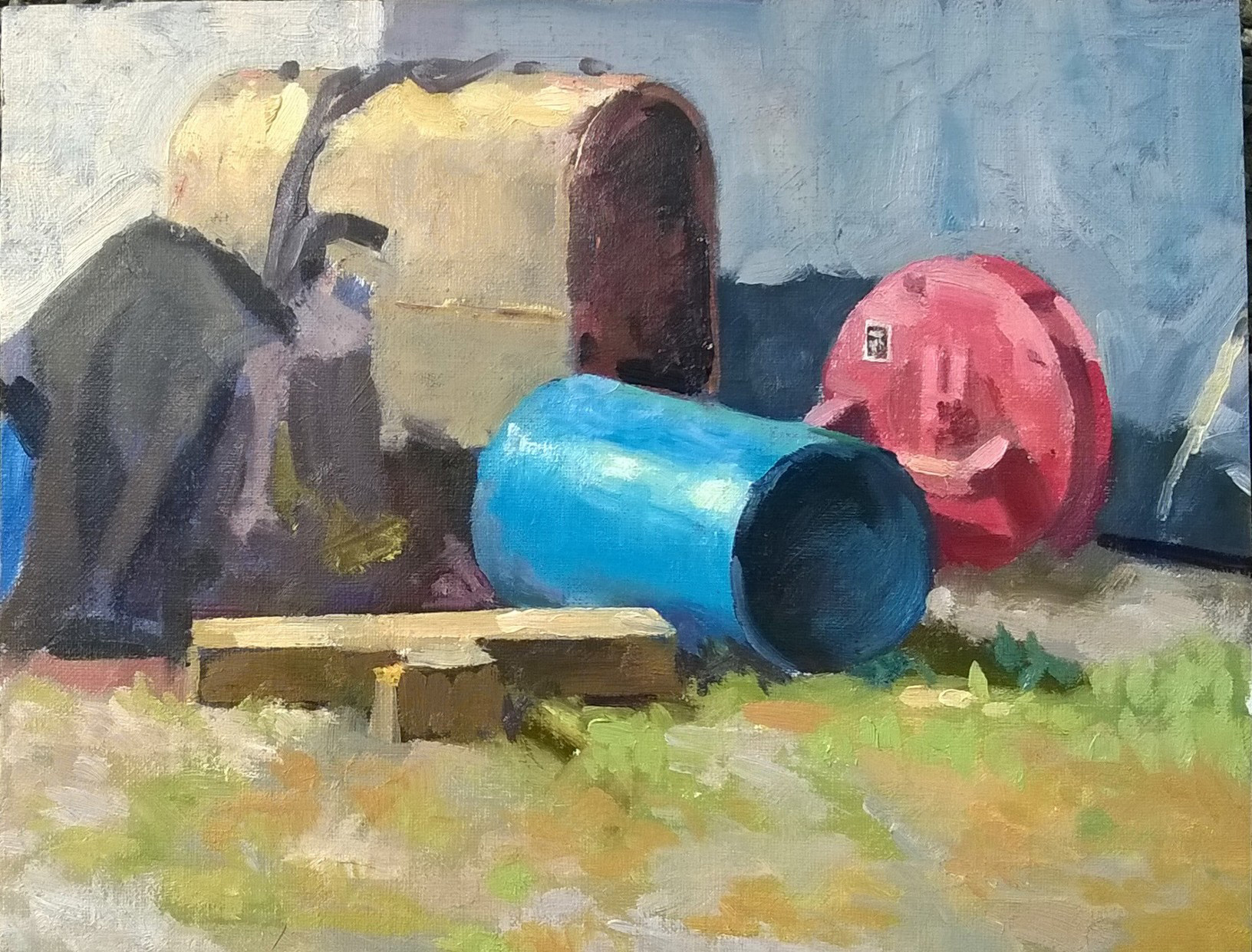
10_10_2016_day2.jpg

On the second and final day I restated everything, bringing the drawing into a little better focus. And I added the reflected light to the side planes of the wood block, and some in the interior surface of the blue cylinder.

The red object is a spool around which heavy cable gets wound.

Good luck trying to sell something like this, although it does what a good small picture should do: it's a simple, peaceful arrangement of shapes, a little 16x20" oasis of logic and clarity which really ought to be hanging in the home of someone who thrives on clearheaded thinking, and love. Which is exactly what happened. Currently it hangs on the wall in the home of my son Dylan Bell.
Spillway Girl Revisited, Part One

This past February when I prepared to spend six weeks in Charleston, SC, I did lunch with Carl Samson and Richard Luschek, and shared my objectives for the pictures I intended to paint in the Low Country and afterward.

There were three. I wanted to work larger, I wanted to solve all drawing problems in advance of beginning to paint, and I wanted figures in my pictures.

Carl stopped me at that last one. "No, you don't want figures. You want meaningful figures."

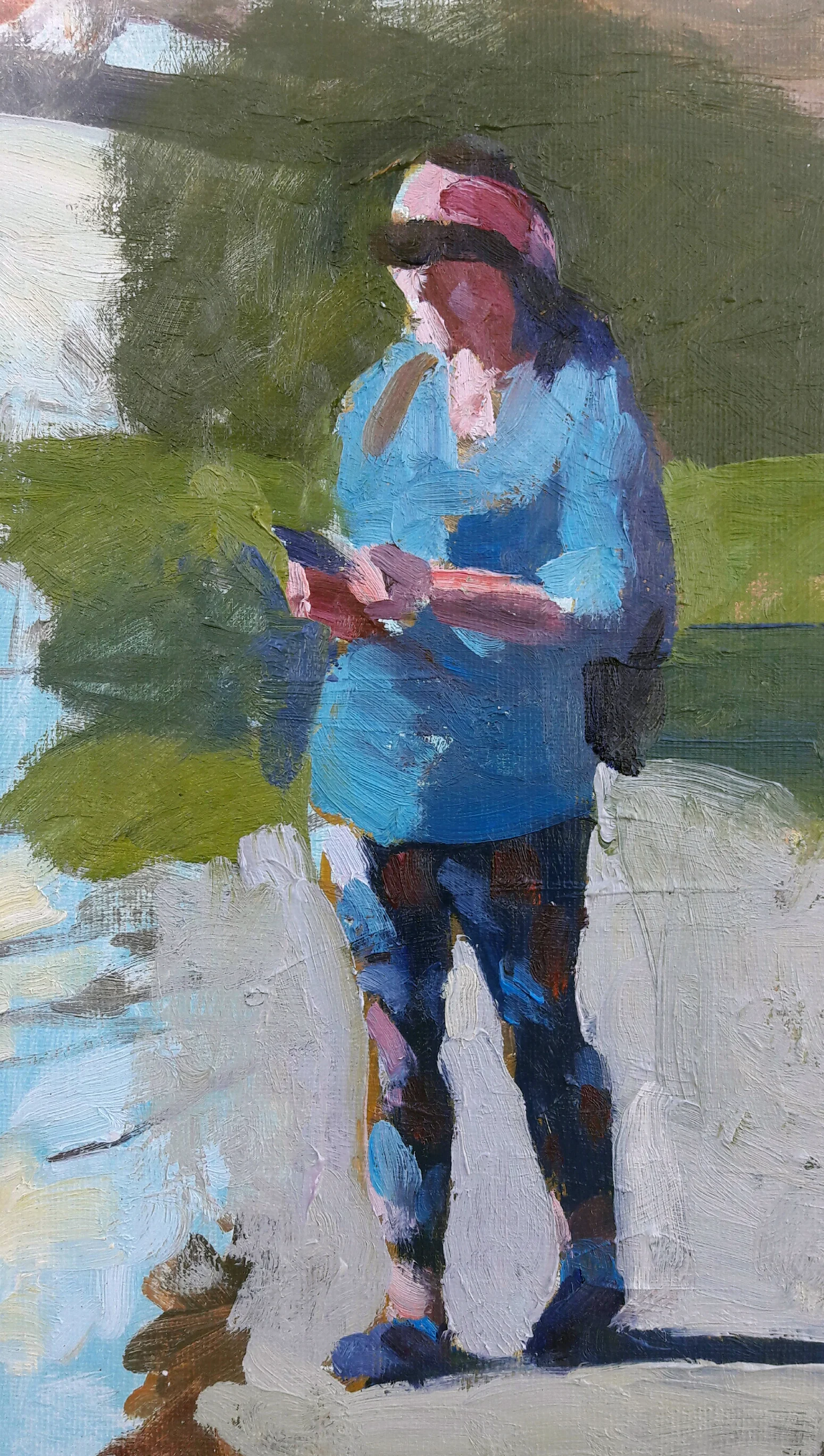
This is why it pays to have friends, and particularly, friends who've already walked the path you intend to tread. The first Charleston picture I finished paid homage to all three of my stated objectives, but not to Carl's caveat. Here's an oil sketch of the picture's star. It took me fifteen minutes, and was far more satisfying than the finished picture itself.

3_3_2017_sketch.jpg

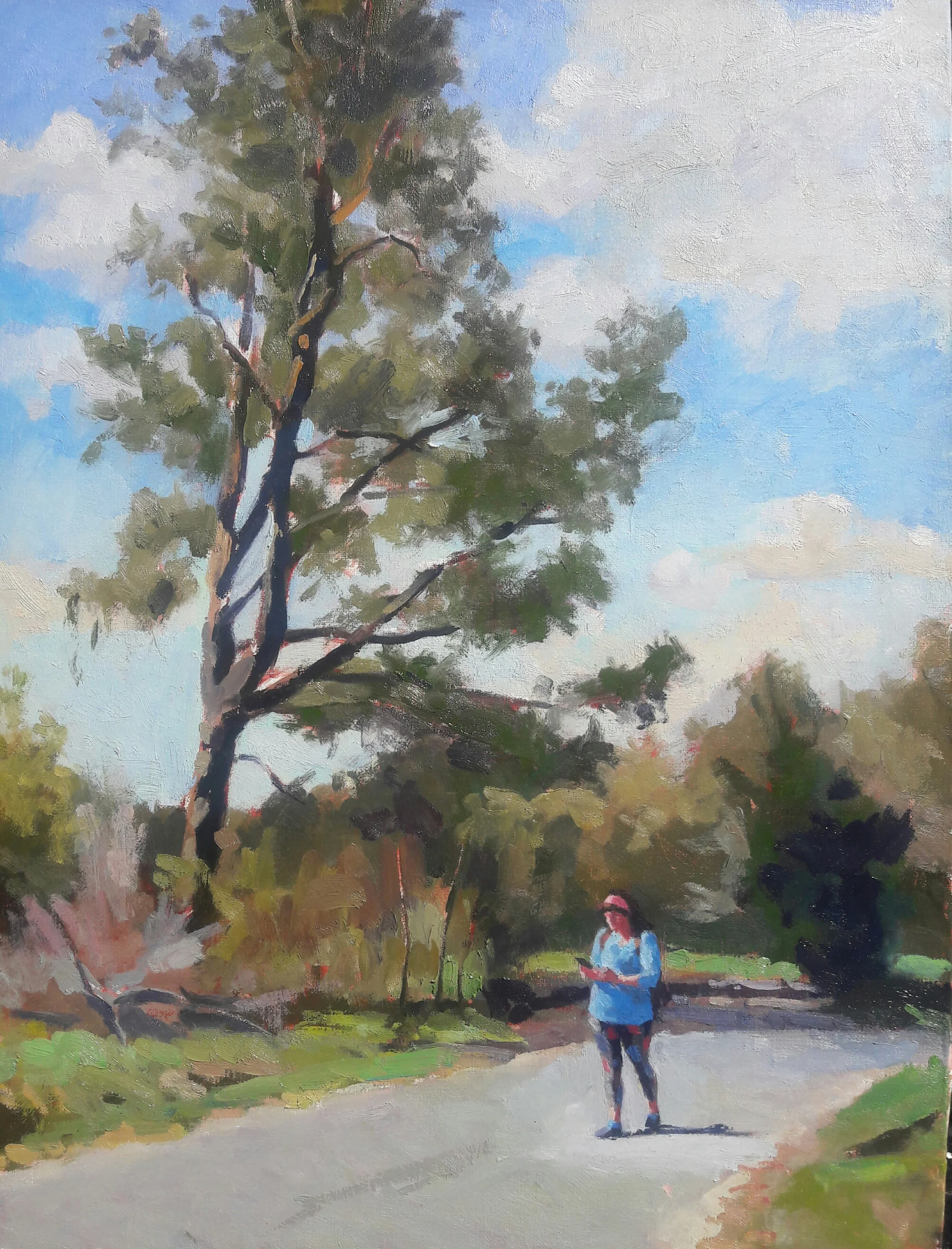
This was to be my Texting Woman opus. I persuaded a local woman to pose for me, and did this rapid sketch. For some time I've wanted to do a picture of someone sending a text message while traipsing through an idyllic landscape. This was my chance. I did all of the things I'd intended: worked large, had a figure, and in the course of doing several sketches like this one, tried my best to solve all drawing problems in advance.

3_3_2017_day6.jpg

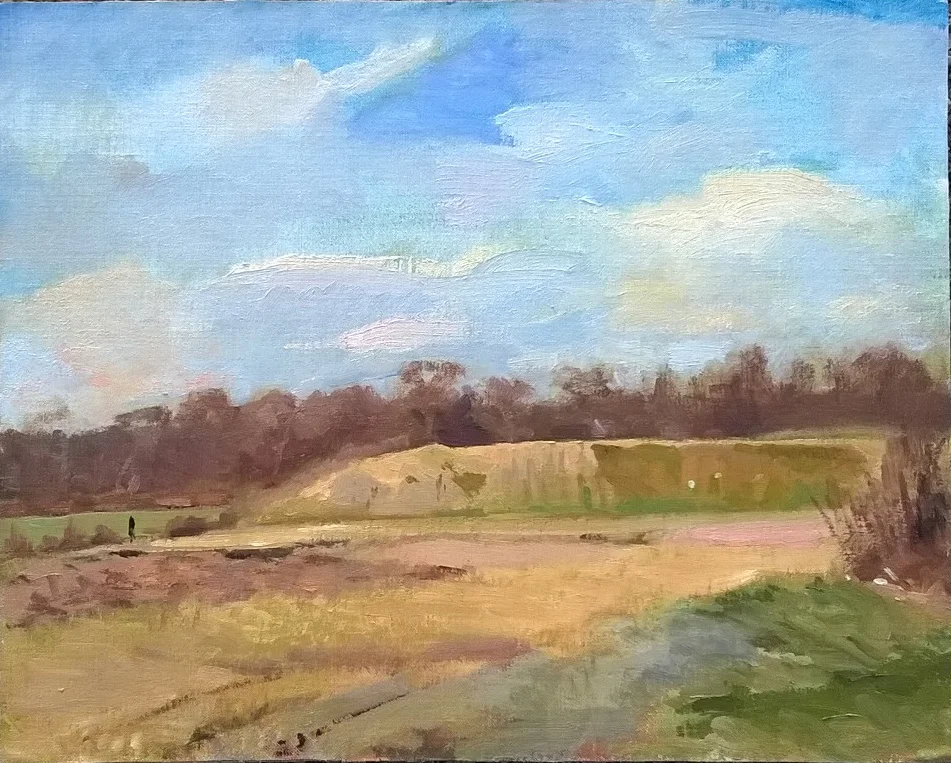
But it was a scene which I could never get excited about. I'm not sure why not. The tree and roadway had been studied and sketched at length. It should have worked, but it did not. The figure was meaningful enough, but the whole scene wasn't. Maybe I was in a hurry. It wasn't all that interesting a scene; mostly it was convenient. And it takes time to find an area's great motifs, the ones which beg to be painted. I had my sketch of the woman. I could have waited till I found the appropriate country road for her to ignore. But I didn't. Haste makes waste.

I guess another factor is the time of year. Summer and fall are times that seem given to good pictures; they're punched up with color. Late winter and early spring are desolate by comparison. Where's the pictorial irony of a woman ignoring a desolate landscape in favor of her smartphone? Honestly, who could blame her?

Later I did find plenty of meaningful vistas in Charleston and did some good pictures there, but this one ain't one of 'em.

6_10_2017_day5 2.jpg

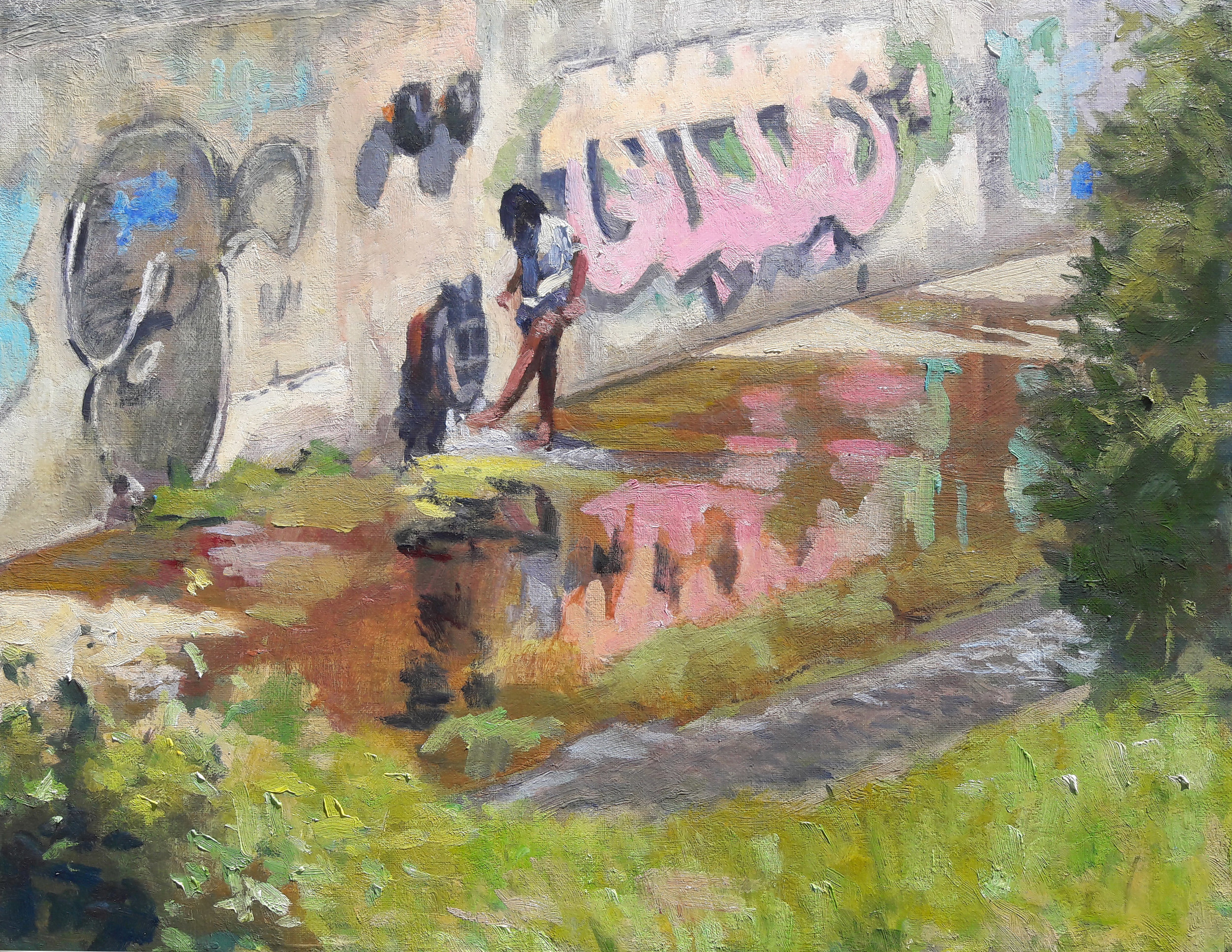
Fast forward to June, when after putting in four sessions on a view of the Duck Creek Spillway, I spied a young woman wandering through the trench and prevailed on her to pose. The result was Carl Samson's "meaningful" figure. She turned an unfocused urban landscape picture into a genre piece.

It was a nice little picture, worth its five sessions (or approximately fifteen hours) or work. but little pictures weren't my objective. I wanted bigger, fully realized compositions, and my Spillway Girl seemed worth a more monumental treatment.

The model was willing to give me a shot. We exchanged phone numbers, and I stretched a much larger canvas.

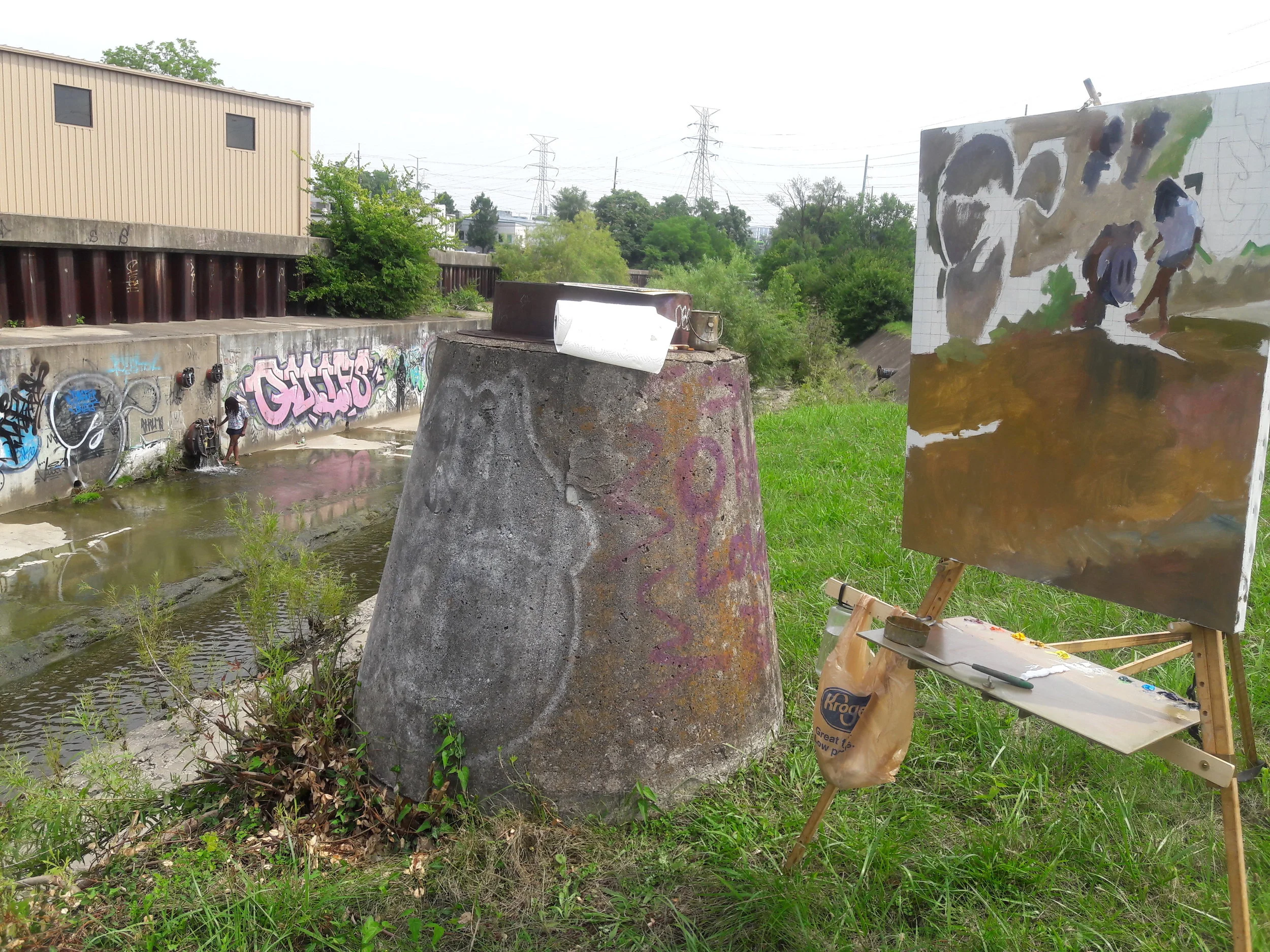
setup.jpg

So in early July, the woman and I rendezvoused at the spillway, me with a larger canvas and she with a giving heart. The truncated cone structure in the center of this snapshot is the foliage-laden object in the foreground of the earlier picture. In between that pic's completion and this one's beginning, they'd done some trimming on my side of the spillway.

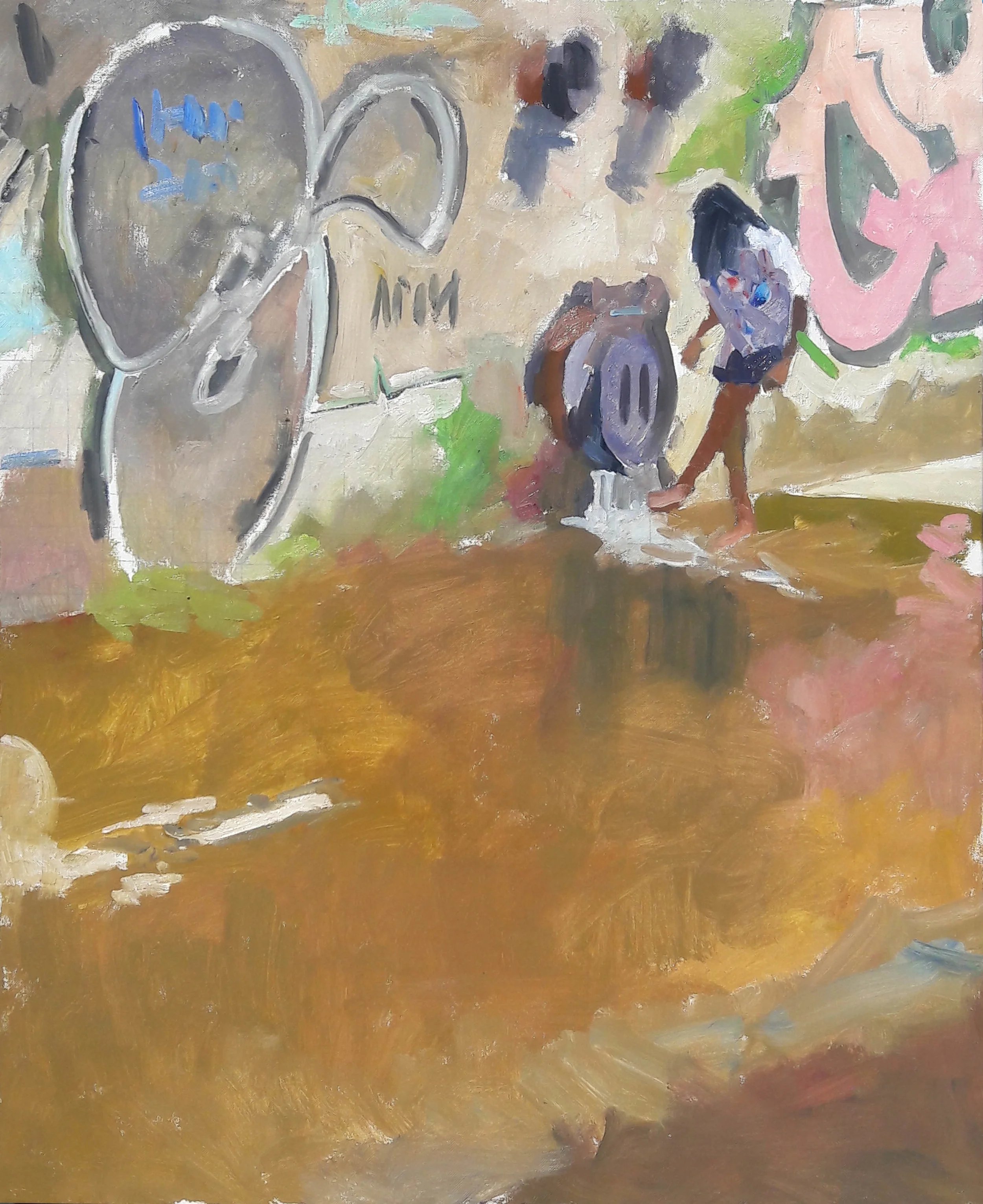
7_12_2017_day1.jpg

This was Day One. I think the best one can hope for on the first day is to cover the canvas, to give yourself a pictorial environment in which decisions can be evaluated and, if necessary, corrected. I got the canvas covered.

It is helpful to not build up huge mounds of paint while outlines are still being figured out. This picture got scraped down a few hours after the end of each session. The alternative is silly. If paint is built up along a sitter's outline, this leaves you with no opportunity to adjust that outline, or lose it altogether. Ernest Hemingway famously said that if you removed all of the pretty words from a passage and it still had some punch, then you had a good passage. The same is true of hard outlines and a buildup of paint, at least at the beginning. Such elements are a tool, but a tool not to be used until pretty much everything is figured out.

At Day One, my story was, in ascending order, about three things: pavement soaked with water from the sluice gate, graffiti, and the woman washing her feet. In terms of physical area, the pavement was the largest, the graffiti the second largest, and the woman the smallest. In terms of focus, the pavement wanted the least, the graffiti the medium, and the woman the most. The plan was to provide the viewer's eye with a large surface to contemplate and wander around in, but to leave that viewer no option other than to return to the woman. There are such things as ensemble movies, like Robert Altman's Nashville, or Tarantino's Reservoir Dogs, or Parenthood or The Best Years of Our Lives. But like most films you love the most, this painting was not to be an ensemble. My Spillway Girl was to be the one and only star.

Whether or not that was a good plan, it was the plan, and in the eleven subsequent sessions, that plan was never changed. Day One was the picture's melody, and I was satisfied with it. For the next couple of weeks, I would be tasked with tweaking its instrumentation and arrangement. But the melody never changed. I think time proved that it was a good melody.


Chasing the Golden Hour

Cinematographers call the hour preceding sunset The Golden Hour. The descending sun's light takes on an orange hue; slanted and upright objects, such as trees, mountains and people, are spotlighted by that orange. It's a lovely time, and particularly in autumn and winter, when the dimming light of the sun is depressing as all get out, except during The Golden Hour. Famously, David Watkin tried to schedule as many exteriors as possible of his film Catch-22 during The Golden Hour. Landscapes painted during the dark seasons are often painted during The Golden Hour. Autumn still looks like autumn, but it's brilliant and shimmering.

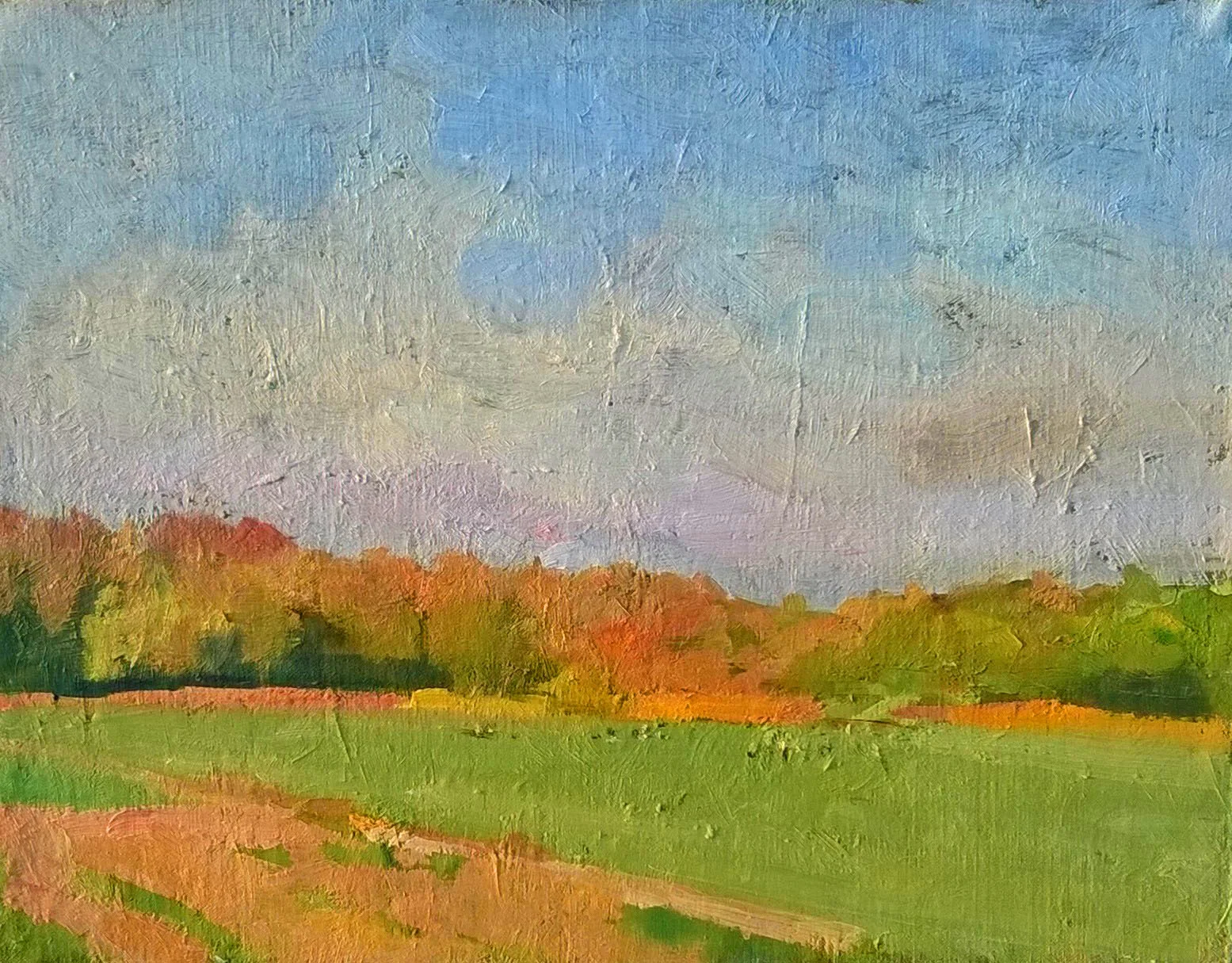
Two years ago, in late October, I became fascinated with a goose field in Newtown, Ohio during The Golden Hour, and sketched the light effect very rapidly:

10_23_2015_2_day1_adj.jpg

One of the things every painter learns sooner or later is that to obtain an effect of bright light, white paint is not a good tool. Bright light does not equal white, which actually is quite cool, but rather it equals intense color — particularly intense warm color. Even the greens seen above are warm, obtained by mixing ultramarine with cadmium yellow medium, rather than cadmium lemon.

This sketch was done over a previous painting, which perhaps explains the rough texture. It took all of fifteen minutes to paint. The little flecks seen at the far edge of the field are geese. It would take me two years to come up with a satisfactory way of indicating those geese in a larger picture.

10_26_2015_day1.jpg

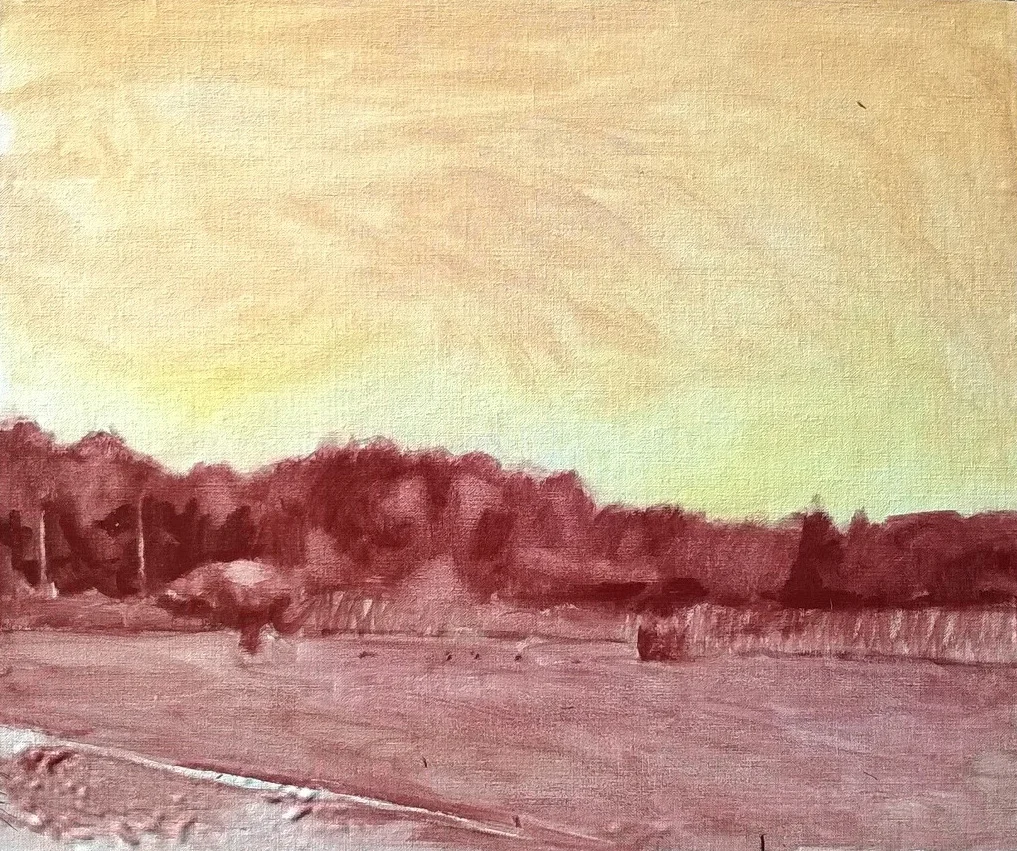
A couple of days later I returned to the spot with a 20x24" canvas. I did this underpainting. Not sure why I chose this Indian Red for the ground, but pale yellows and oranges are often very good for skies, especially skies one intends to paint in blues later on.

Possibly the Indian Red was chosen as a complimentary color to the greens of grass and foliage, as well as being a pigment capable of producing fairly dark values. But looking back, if it's throbbing compliments I was after, as well as a pigment that could give me darks when necessary, wouldn't Ultramarine have been a good choice, as something to be overpainted in various oranges?

But heck, this was 2015, back when I was very young. I had heard about the need to have one hue pervading and dominating a scene, but I hadn't yet accepted and embraced the notion. Not, at least, to the extent that I could use it in the scoping out of color, and the selection of pigments for underpainting.

10_26_2015_ref.jpg

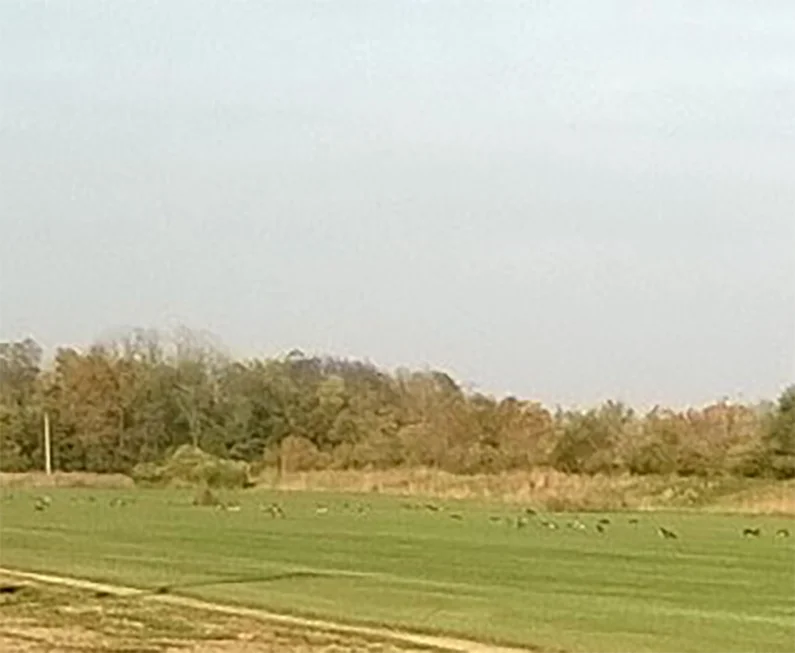
Here's a snapshot of the scene taken that day, but the real Golden Hour hadn't quite arrived.

10_23_2015_day3b.jpg

I think scenes such as this one, with a strong light effect, testify as to the folly of looking into its various components, instead of taking jn the whole scene at once. The more I'd look into the sky, the more blue I saw. But the whole scene is essentially orange. Orange, in the parlance of some painters, is the scene's Mother Color. That effect was lost here.

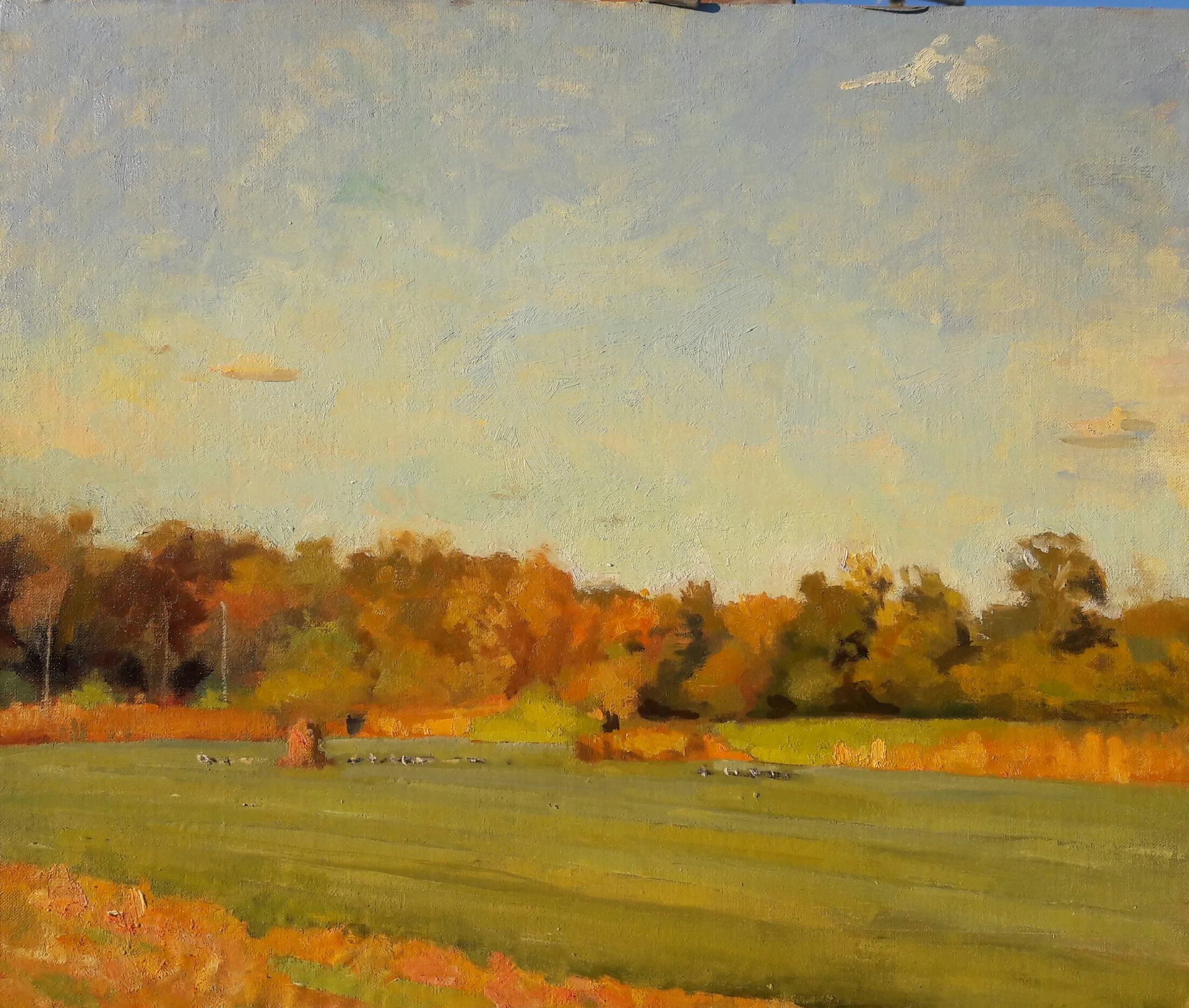
10_26_2015_day6.jpg

This alteration was made last year about this time. The strong oranges suggest The Golden Hour. The sky's blues had to be tempered with yellow, or that orange domination would be gone. In some ways, this state is superior to the "final" version I completed yesterday.

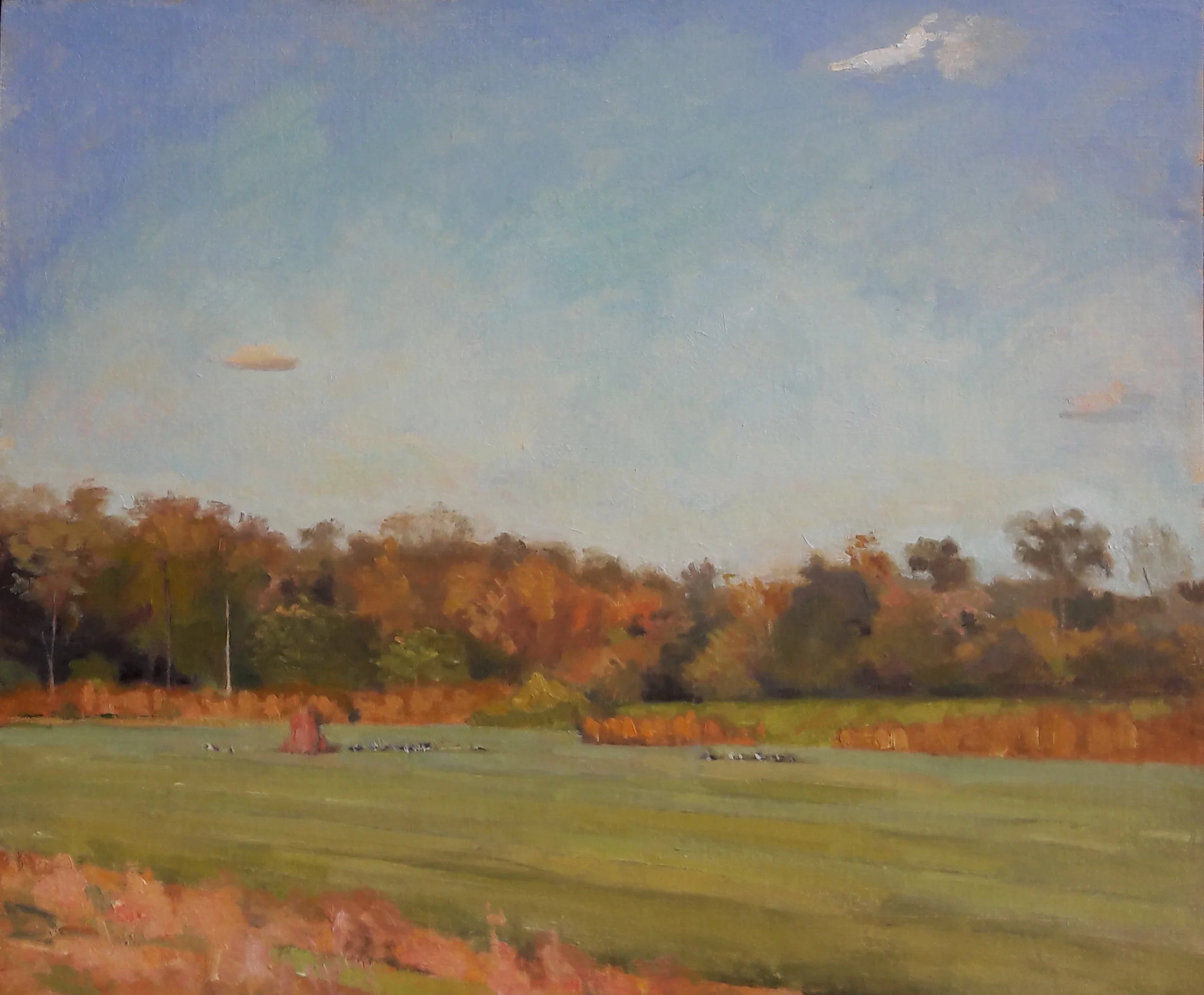
10_26_2015_day8c.jpg

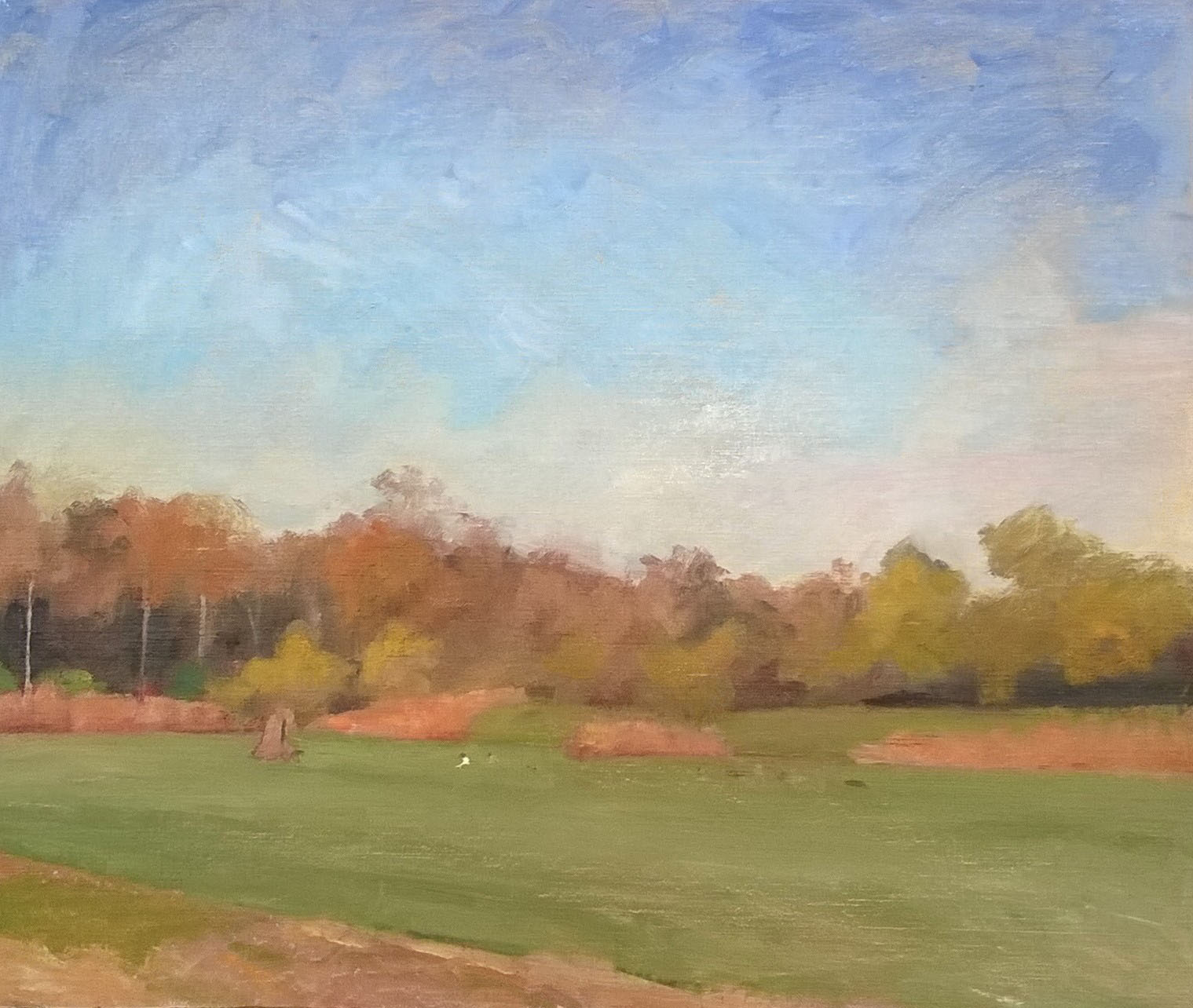
Here's the final session on the picture from last year. It didn't end on a good note; i looked into the sky again, and lost some of the intense light on upright planes. Thus did the picture look for another year, leaning against the wall. An unfinished picture, particularly one fraught with unsolved problems, hangs like Damocles' sword. It cries for solutions. It cries for understanding which one may not yet have.

And it's a souvenir of earlier times, times when 20x24" was my idea of a full size picture. Today, anything smaller than 20x24" is a miniature to me. I've run out of stretched and mounted canvi, and have to cut up some plywood soon, upon which canvas can be glued. I think I'm going to go after 20x24" and 24x28", a bunch of 'em. Between those and the scores of failed pictures of yore, I've got many square yards upon which I can learn and teach.

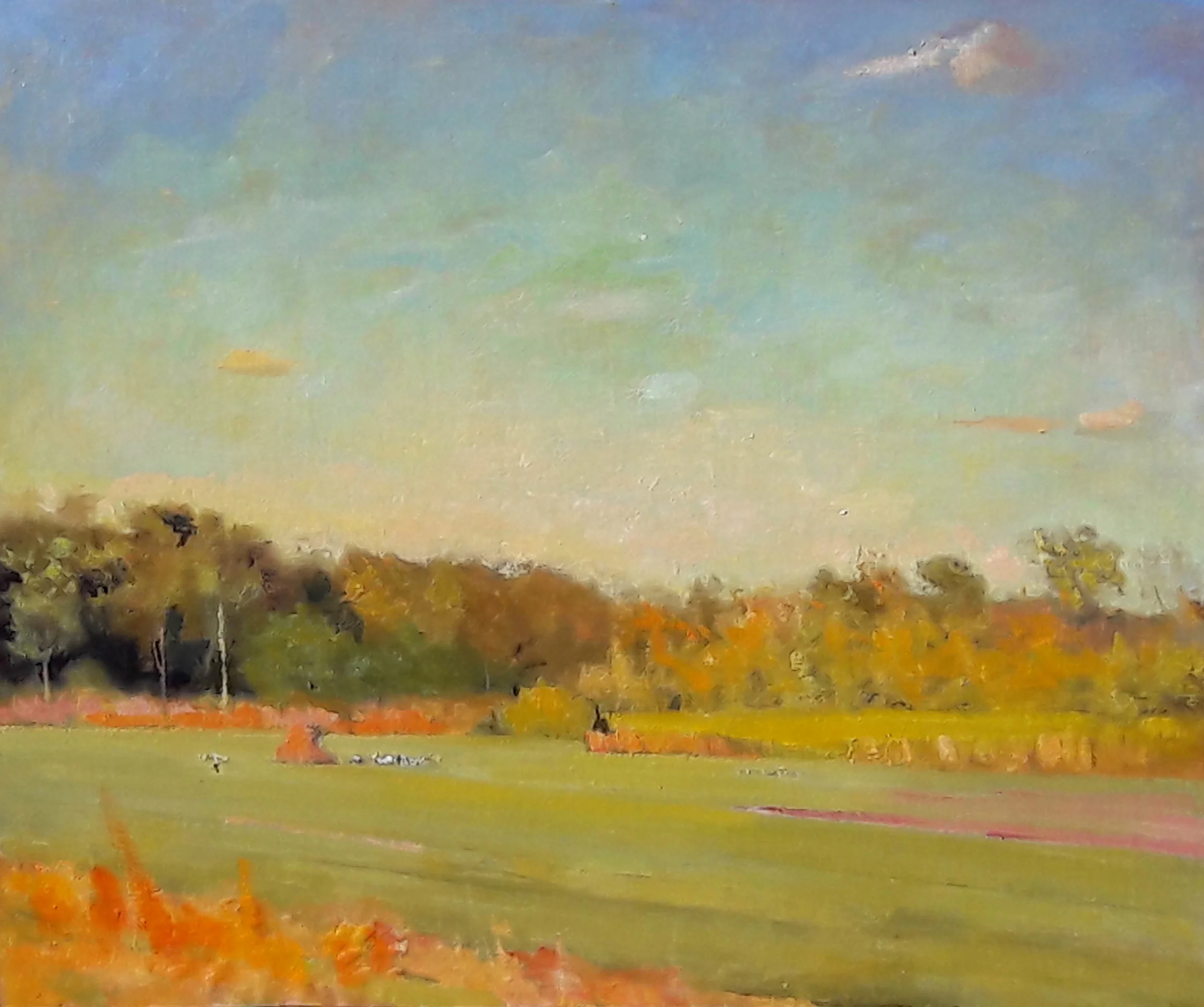
10_26_2015_day10.jpg

This was yesterday's effort. Maybe I'm done. Maybe the scene, and the picture, aren't worth further futzing. I think I got my Golden Hour, at least as well as I did two years ago with a used canvas and fifteen minutes.